
Photo Club Meeting 1: Orientation
Photo Club Meeting 1: Orientation
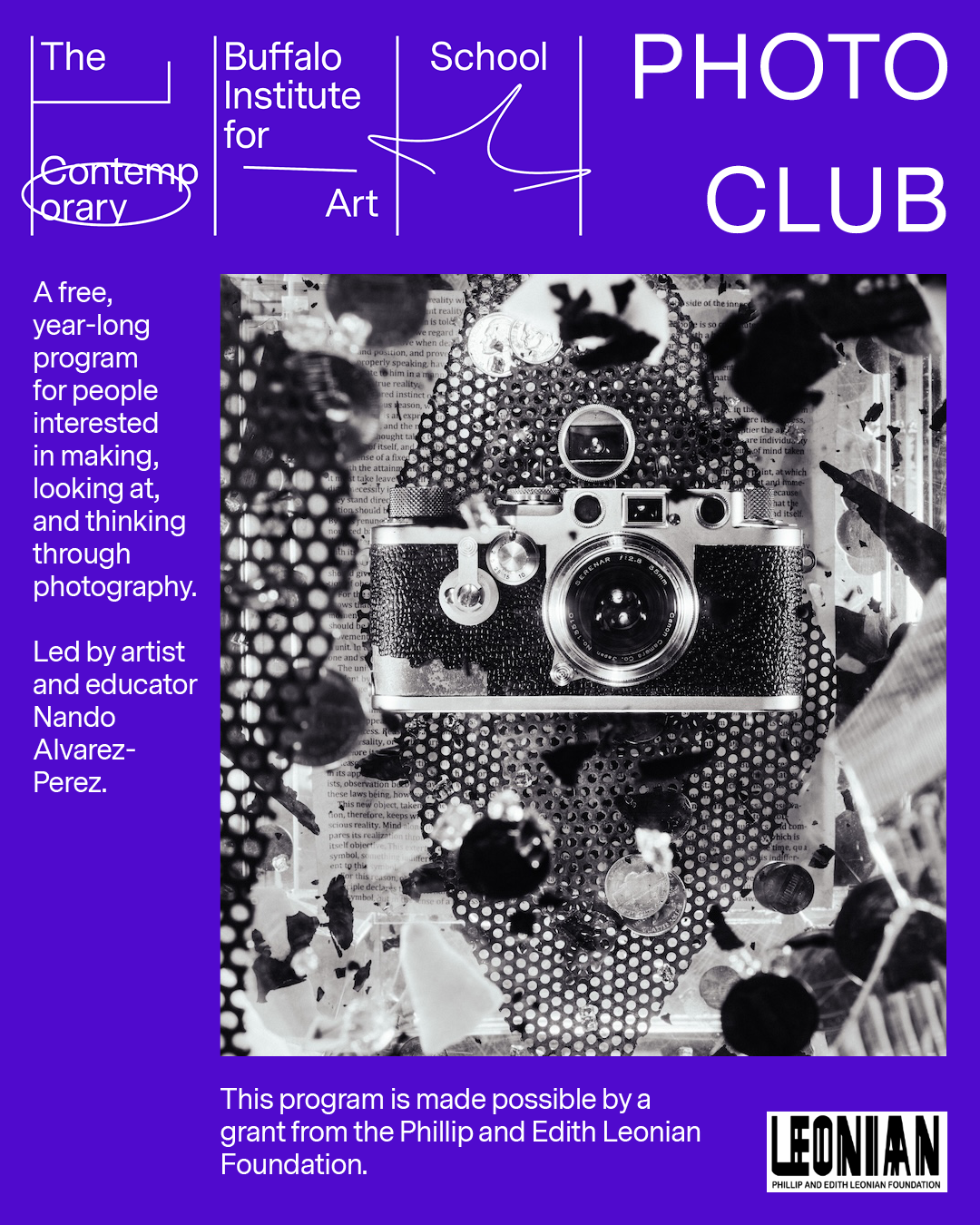
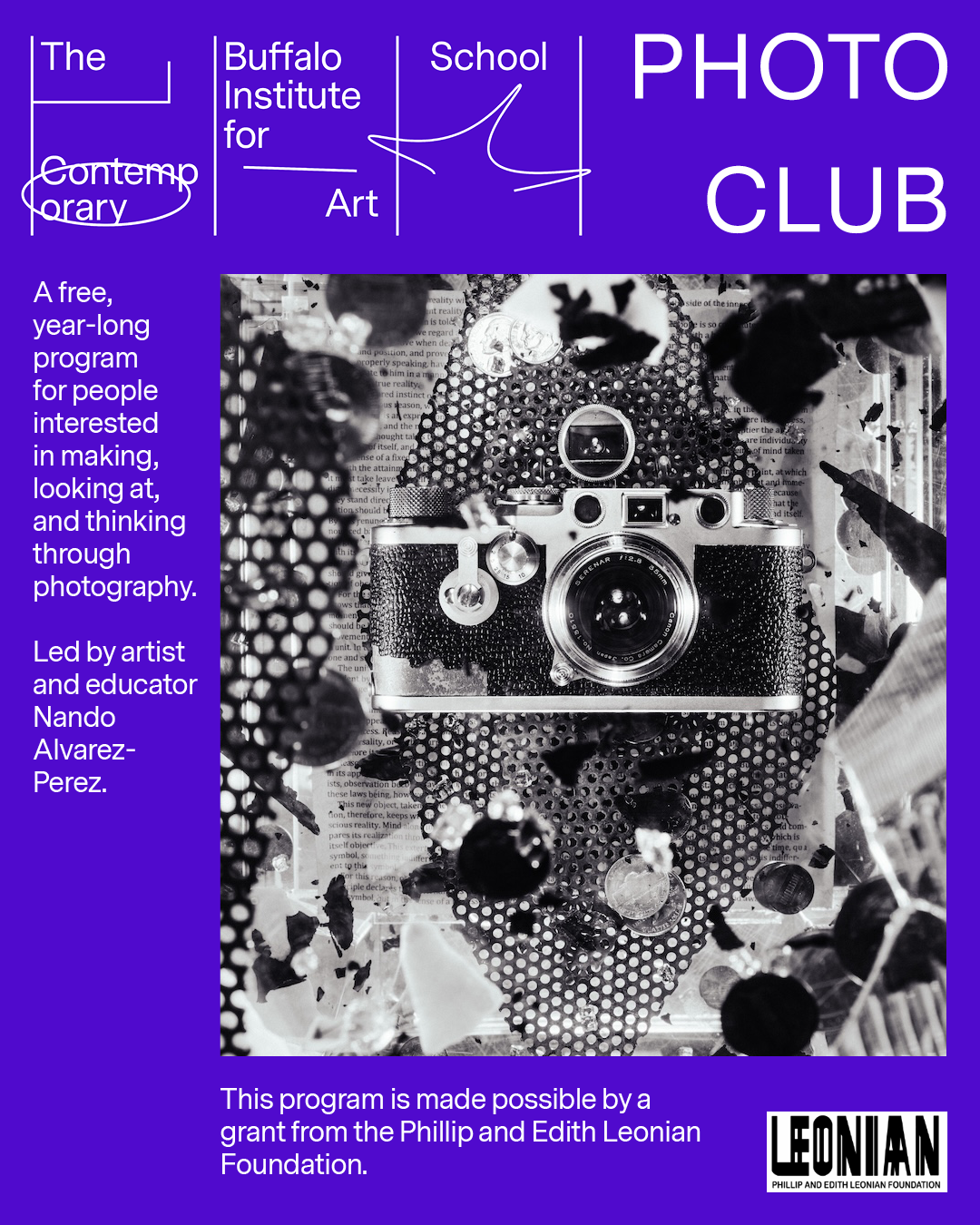
BICA School Photo Club is a free, year-long program for people interested in making, looking at, and thinking through photography. Led by artist and educator Nando Alvarez-Perez through BICA School but open to all, Photo Club will meet regularly from September 2026 through May 2027, with a public presentation of participants’ work in June.
Meetings will move between making photographs, learning and sharing technical skills, reading and discussion, looking closely at photographs, and group critique. Participants will develop their own projects while studying photography’s tools, histories, and ideas—and considering what photographs can tell us about the lives, places, and conditions we inhabit.
This program is made possible by a grant from the Phillip and Edith Leonian Foundation.
Who is it for?
Photo Club is open to any level of photographic experience. You might have been making photographs for years or still be figuring out how your camera works. What matters is curiosity, a willingness to experiment, and an interest in learning alongside other people. Knowledge is useful here; not knowing something yet is useful, too.
Participants should be prepared to attend regularly, make photographs between meetings, bring work and ideas into conversation, and complete occasional readings.
Participants will need:
access to a digital camera
access to a computer
access to photo-editing software (check out Affinity if you’re looking for Adobe alternatives!)
Schedule
Meetings: Saturdays, 12–3pm
Fall 2026
September 26 — Orientation
October 10 — Instruction
November 14 — Critique/check-in
December 12 — Final fall meeting
Spring 2027
January 16 — Spring relaunch
January 30
February 13
February 27
March 13
March 27
April 17
May 1
May 15
May 29 — Final working meeting
Public presentation: June 2027 (date TBD)
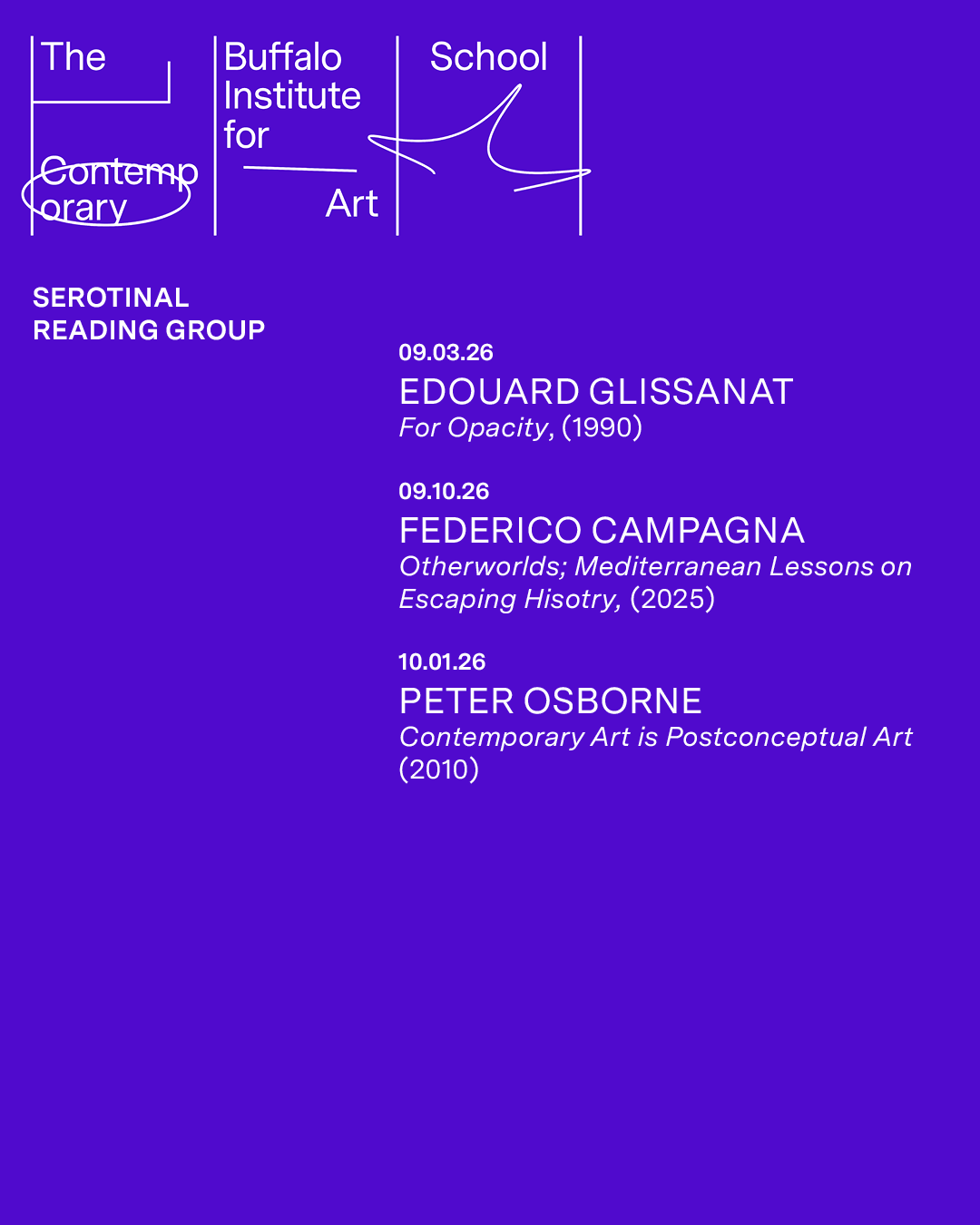
BICA School Reading Group: Peter Osborne
BICA School Lab | 30 Essex Street
Open to All | Free to Join | No Registration Required
Join us at BICA School for a casual, come-as-you-are reading group that welcomes everyone—whether you've read the text cover to cover or just want to hear what others have to say. We'll explore critical and curious texts together in a space that values open conversation, listening, and learning.
Read ahead if you can, but there's no pressure to be an expert—bring your thoughts, questions, and curiosity.
→ Osborne, Peter. Contemporary Art is Postconceptual Art (2010)
Photo Club Meeting 2: Instruction
Photo Club Meeting 2: Instruction
BICA School Photo Club is a free, year-long program for people interested in making, looking at, and thinking through photography. Led by artist and educator Nando Alvarez-Perez through BICA School but open to all, Photo Club will meet regularly from September 2026 through May 2027, with a public presentation of participants’ work in June.
Meetings will move between making photographs, learning and sharing technical skills, reading and discussion, looking closely at photographs, and group critique. Participants will develop their own projects while studying photography’s tools, histories, and ideas—and considering what photographs can tell us about the lives, places, and conditions we inhabit.
This program is made possible by a grant from the Phillip and Edith Leonian Foundation.
Who is it for?
Photo Club is open to any level of photographic experience. You might have been making photographs for years or still be figuring out how your camera works. What matters is curiosity, a willingness to experiment, and an interest in learning alongside other people. Knowledge is useful here; not knowing something yet is useful, too.
Participants should be prepared to attend regularly, make photographs between meetings, bring work and ideas into conversation, and complete occasional readings.
Participants will need:
access to a digital camera
access to a computer
access to photo-editing software (check out Affinity if you’re looking for Adobe alternatives!)
Schedule
Meetings: Saturdays, 12–3pm
Fall 2026
September 26 — Orientation
October 10 — Instruction
November 14 — Critique/check-in
December 12 — Final fall meeting
Spring 2027
January 16 — Spring relaunch
January 30
February 13
February 27
March 13
March 27
April 17
May 1
May 15
May 29 — Final working meeting
Public presentation: June 2027 (date TBD)
Photo Club Meeting 3: Critique/check-in
Photo Club Meeting 3: Critique/check-in
BICA School Photo Club is a free, year-long program for people interested in making, looking at, and thinking through photography. Led by artist and educator Nando Alvarez-Perez through BICA School but open to all, Photo Club will meet regularly from September 2026 through May 2027, with a public presentation of participants’ work in June.
Meetings will move between making photographs, learning and sharing technical skills, reading and discussion, looking closely at photographs, and group critique. Participants will develop their own projects while studying photography’s tools, histories, and ideas—and considering what photographs can tell us about the lives, places, and conditions we inhabit.
This program is made possible by a grant from the Phillip and Edith Leonian Foundation.
Who is it for?
Photo Club is open to any level of photographic experience. You might have been making photographs for years or still be figuring out how your camera works. What matters is curiosity, a willingness to experiment, and an interest in learning alongside other people. Knowledge is useful here; not knowing something yet is useful, too.
Participants should be prepared to attend regularly, make photographs between meetings, bring work and ideas into conversation, and complete occasional readings.
Participants will need:
access to a digital camera
access to a computer
access to photo-editing software (check out Affinity if you’re looking for Adobe alternatives!)
Schedule
Meetings: Saturdays, 12–3pm
Fall 2026
September 26 — Orientation
October 10 — Instruction
November 14 — Critique/check-in
December 12 — Final fall meeting
Spring 2027
January 16 — Spring relaunch
January 30
February 13
February 27
March 13
March 27
April 17
May 1
May 15
May 29 — Final working meeting
Public presentation: June 2027 (date TBD)
Photo Club Meeting 4: Final fall meeting
Photo Club Meeting 4: Final fall meeting
BICA School Photo Club is a free, year-long program for people interested in making, looking at, and thinking through photography. Led by artist and educator Nando Alvarez-Perez through BICA School but open to all, Photo Club will meet regularly from September 2026 through May 2027, with a public presentation of participants’ work in June.
Meetings will move between making photographs, learning and sharing technical skills, reading and discussion, looking closely at photographs, and group critique. Participants will develop their own projects while studying photography’s tools, histories, and ideas—and considering what photographs can tell us about the lives, places, and conditions we inhabit.
This program is made possible by a grant from the Phillip and Edith Leonian Foundation.
Who is it for?
Photo Club is open to any level of photographic experience. You might have been making photographs for years or still be figuring out how your camera works. What matters is curiosity, a willingness to experiment, and an interest in learning alongside other people. Knowledge is useful here; not knowing something yet is useful, too.
Participants should be prepared to attend regularly, make photographs between meetings, bring work and ideas into conversation, and complete occasional readings.
Participants will need:
access to a digital camera
access to a computer
access to photo-editing software (check out Affinity if you’re looking for Adobe alternatives!)
Schedule
Meetings: Saturdays, 12–3pm
Fall 2026
September 26 — Orientation
October 10 — Instruction
November 14 — Critique/check-in
December 12 — Final fall meeting
Spring 2027
January 16 — Spring relaunch
January 30
February 13
February 27
March 13
March 27
April 17
May 1
May 15
May 29 — Final working meeting
Public presentation: June 2027 (date TBD)
Photo Club Meeting 5: Spring relaunch
Photo Club Meeting 5: Spring relaunch
BICA School Photo Club is a free, year-long program for people interested in making, looking at, and thinking through photography. Led by artist and educator Nando Alvarez-Perez through BICA School but open to all, Photo Club will meet regularly from September 2026 through May 2027, with a public presentation of participants’ work in June.
Meetings will move between making photographs, learning and sharing technical skills, reading and discussion, looking closely at photographs, and group critique. Participants will develop their own projects while studying photography’s tools, histories, and ideas—and considering what photographs can tell us about the lives, places, and conditions we inhabit.
This program is made possible by a grant from the Phillip and Edith Leonian Foundation.
Who is it for?
Photo Club is open to any level of photographic experience. You might have been making photographs for years or still be figuring out how your camera works. What matters is curiosity, a willingness to experiment, and an interest in learning alongside other people. Knowledge is useful here; not knowing something yet is useful, too.
Participants should be prepared to attend regularly, make photographs between meetings, bring work and ideas into conversation, and complete occasional readings.
Participants will need:
access to a digital camera
access to a computer
access to photo-editing software (check out Affinity if you’re looking for Adobe alternatives!)
Schedule
Meetings: Saturdays, 12–3pm
Fall 2026
September 26 — Orientation
October 10 — Instruction
November 14 — Critique/check-in
December 12 — Final fall meeting
Spring 2027
January 16 — Spring relaunch
January 30
February 13
February 27
March 13
March 27
April 17
May 1
May 15
May 29 — Final working meeting
Public presentation: June 2027 (date TBD)
BICA School Reading Group: Federico CAMPAGNA
BICA School Lab | 30 Essex Street
Open to All | Free to Join | No Registration Required
Join us at BICA School for a casual, come-as-you-are reading group that welcomes everyone—whether you've read the text cover to cover or just want to hear what others have to say. We'll explore critical and curious texts together in a space that values open conversation, listening, and learning.
Read ahead if you can, but there's no pressure to be an expert—bring your thoughts, questions, and curiosity.
→Campagna, Federico. Otherworlds; Mediterranean Lessons on Escaping History, (2025)
Yes some pages are extremely crooked. Email adobe and tell them they need get rid of “deskew” and just add the ability to rotate pages or sections at anything less than 90 degree angle."Exploring the material importance of myth as a practice in liberation? Federico Campagna discusses how myth can become a practice of imagination, solidarity, and survival. We look at myth’s tension with materialism, and its role in resisting despair."
(partially edited from the acid horizon podcast episode discussing the book with the author)
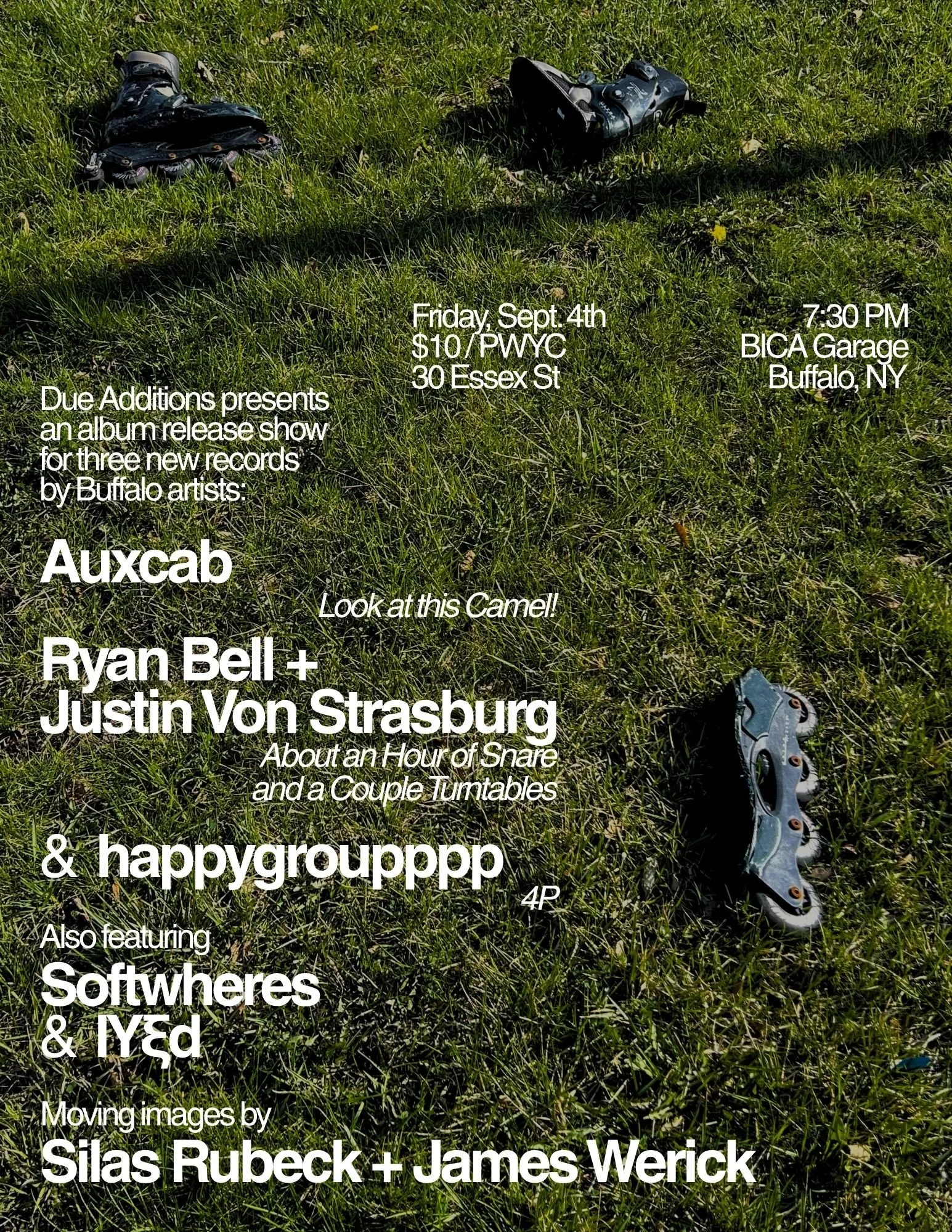
Due Additions presents 3 part Album Release Show
Due Additions presents 3 part Album Release Show
Featuring Auxcab, Ryan Bell & Justin Von-Strasburg, happygroupppp, Softwares & IYĘD, Silas Rubeck & James Werick
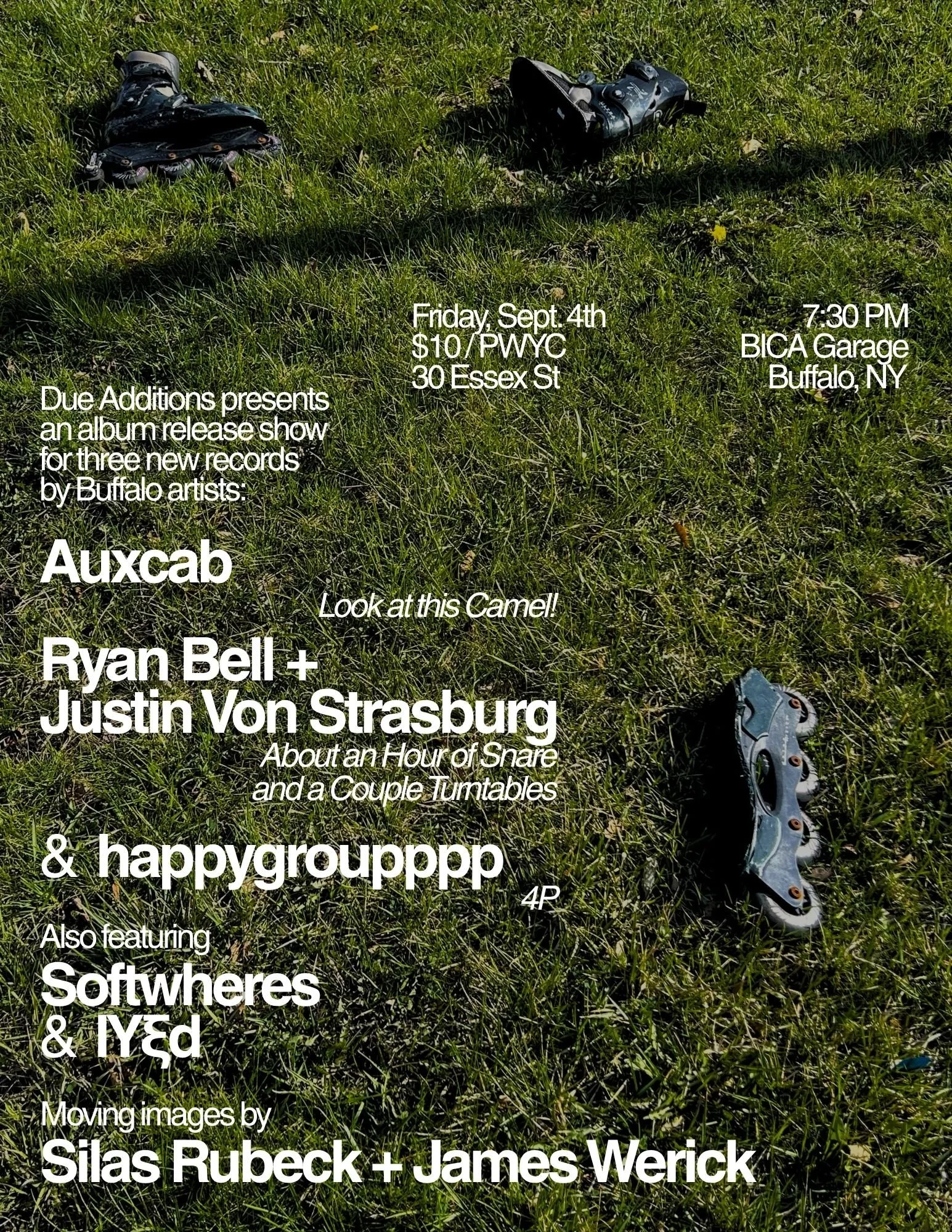
Due Additions presents 3 part Album Release Show featuring:
Auxcab: Look at this Camel!
Ryan Bell & Justin Von-Strasburg: About an Hour of Snare and a Couple Turntables
happygroupppp: 4p
also featuring: Softwares & IYĘD,
moving images by: Silas Rubeck & James Werick
Friday, September, 4th @ 7:30PM
$10/PWYC
BICA GARAGE 30 ESSEX ST
BICA School Reading Group: édouard Glissant
CEPA GALLERY | 617 Main St #201, Buffalo, NY 14203
Open to All | Free to Join | No Registration Required
**this reading group follows a crit from a bica schooler
Join us at BICA School for a casual, come-as-you-are reading group that welcomes everyone—whether you've read the text cover to cover or just want to hear what others have to say. We'll explore critical and curious texts together in a space that values open conversation, listening, and learning.
Read ahead if you can, but there's no pressure to be an expert—bring your thoughts, questions, and curiosity.
We’re going to be discussing the second essay from last week’s reading group alongside a crit of a BICA Schooler’s work. David Foster Wallace had us immersed, we needed more time for Glissant.
Why should we have to fully understand someone to respect them?
Glissant pushes back on the idea that real connection requires total transparency—that we must fully grasp another person or culture in order to value them. He argues for a right to opacity instead: people and cultures can remain partly illegible to each other and still relate, still build solidarity, without one side having to dissolve into something fully knowable by the other. Short, poetic, and quietly radical—a useful counterpoint to Wallace, and to any framework that treats "understanding" as the only path to respect.
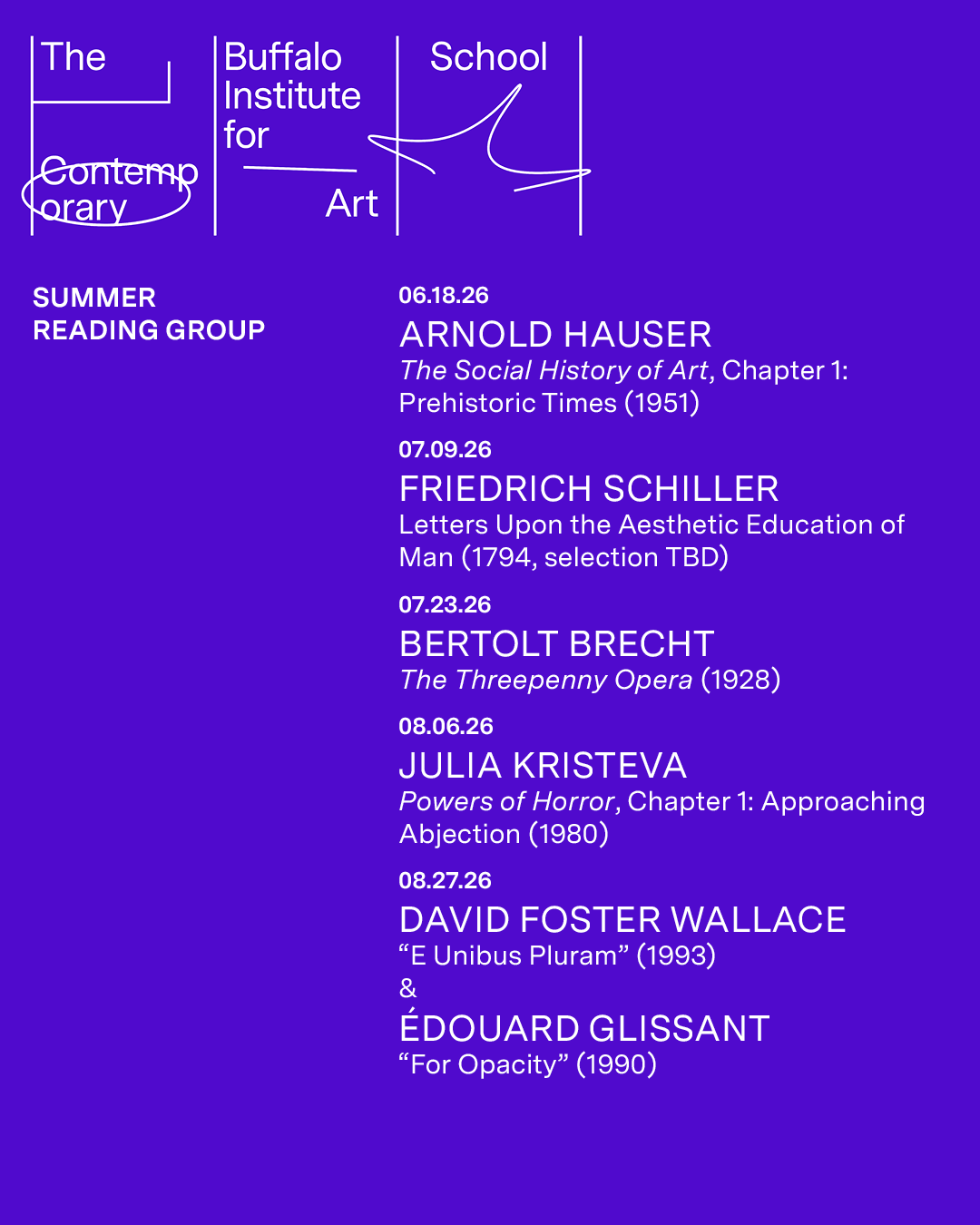
BICA School Reading Group: David Foster Wallace & Edouard Glissant
BICA School Lab | 30 Essex Street
Open to All | Free to Join | No Registration Required
Join us at BICA School for a casual, come-as-you-are reading group that welcomes everyone—whether you've read the text cover to cover or just want to hear what others have to say. We'll explore critical and curious texts together in a space that values open conversation, listening, and learning.
Read ahead if you can, but there's no pressure to be an expert—bring your thoughts, questions, and curiosity.
Two short, very different essays this week—pair them how you like.
What does it mean to grow up fluent in irony?
Wallace's essay argues that television trained a generation of American writers and readers to be endlessly self-aware, endlessly knowing, allergic to sincerity. He's writing as a novelist worried about his own toolkit—if irony is the only mode television has taught us to value, what happens to fiction that wants to mean something? Long and funny in places, sharp and a little anxious throughout, it's an early and still-relevant diagnosis of a problem many people now just call "being online."
Why should we have to fully understand someone to respect them?
Glissant pushes back on the idea that real connection requires total transparency—that we must fully grasp another person or culture in order to value them. He argues for a right to opacity instead: people and cultures can remain partly illegible to each other and still relate, still build solidarity, without one side having to dissolve into something fully knowable by the other. Short, poetic, and quietly radical—a useful counterpoint to Wallace, and to any framework that treats "understanding" as the only path to respect.
BICA School Reading Group: Kristeva, Approaching Abjection
BICA School Lab | 30 Essex Street
Open to All | Free to Join | No Registration Required
Join us at BICA School for a casual, come-as-you-are reading group that welcomes everyone—whether you've read the text cover to cover or just want to hear what others have to say. We'll explore critical and curious texts together in a space that values open conversation, listening, and learning.
Read ahead if you can, but there's no pressure to be an expert—bring your thoughts, questions, and curiosity. Note: Chapter 1 only — the link goes to the full book.
Why does a corpse, or spoiled milk, make us recoil before we even think about it?
Kristeva calls that reaction "the abject"—not quite an object you can name and hold at a distance, and not quite part of you either. It's what gets expelled to keep the boundary of the self intact: filth, waste, anything that blurs the line between inside and outside, self and other, life and death. She traces this further than disgust—into questions of language, religion, and art, suggesting that literature and art have long served as ways of approaching the abject safely, giving form to what otherwise threatens to undo us. Dense in places, but the opening pages are vivid and physical, grounded in concrete sensations before they get philosophical. A challenging, generative read for anyone interested in how art handles what culture would rather not look at directly.
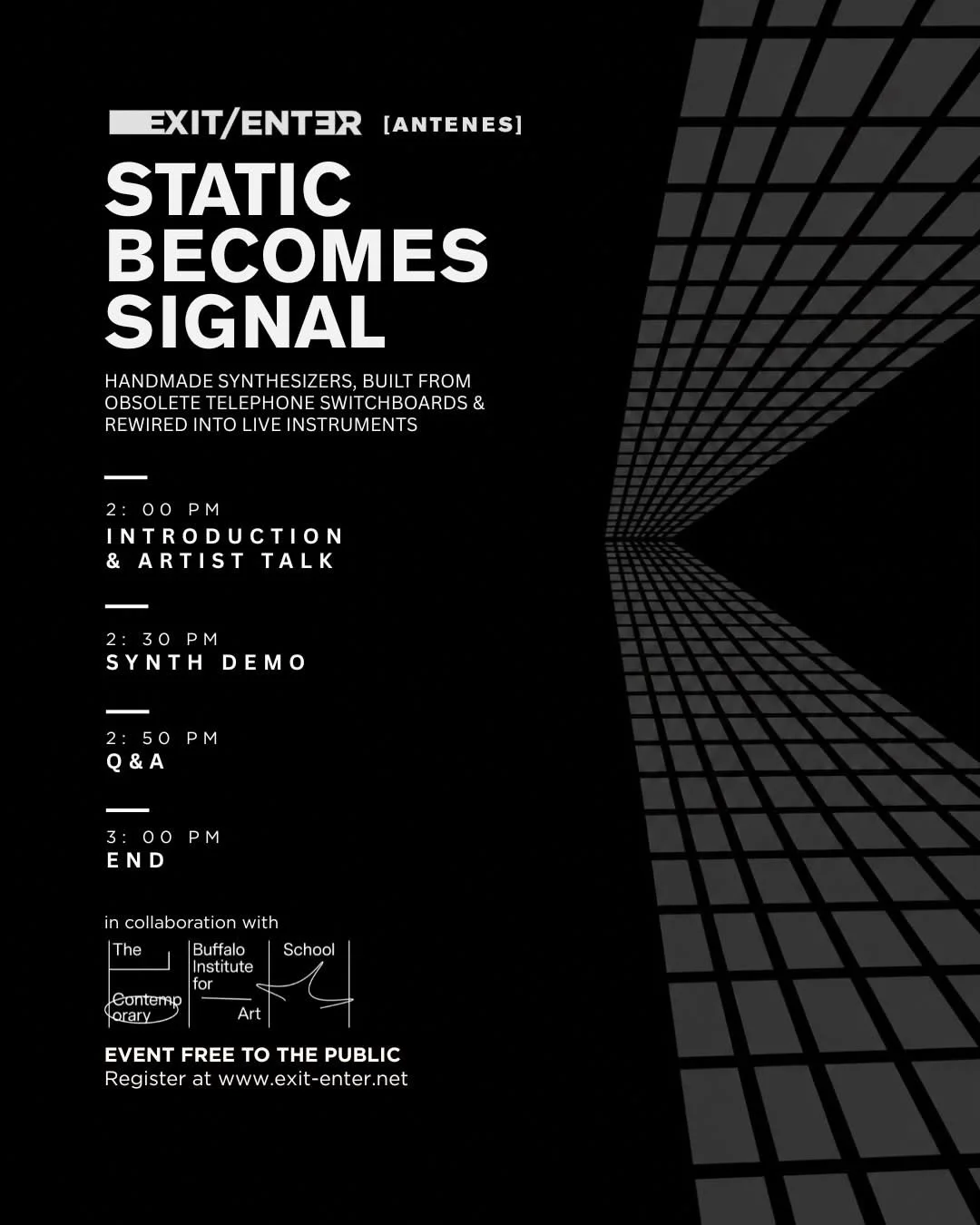
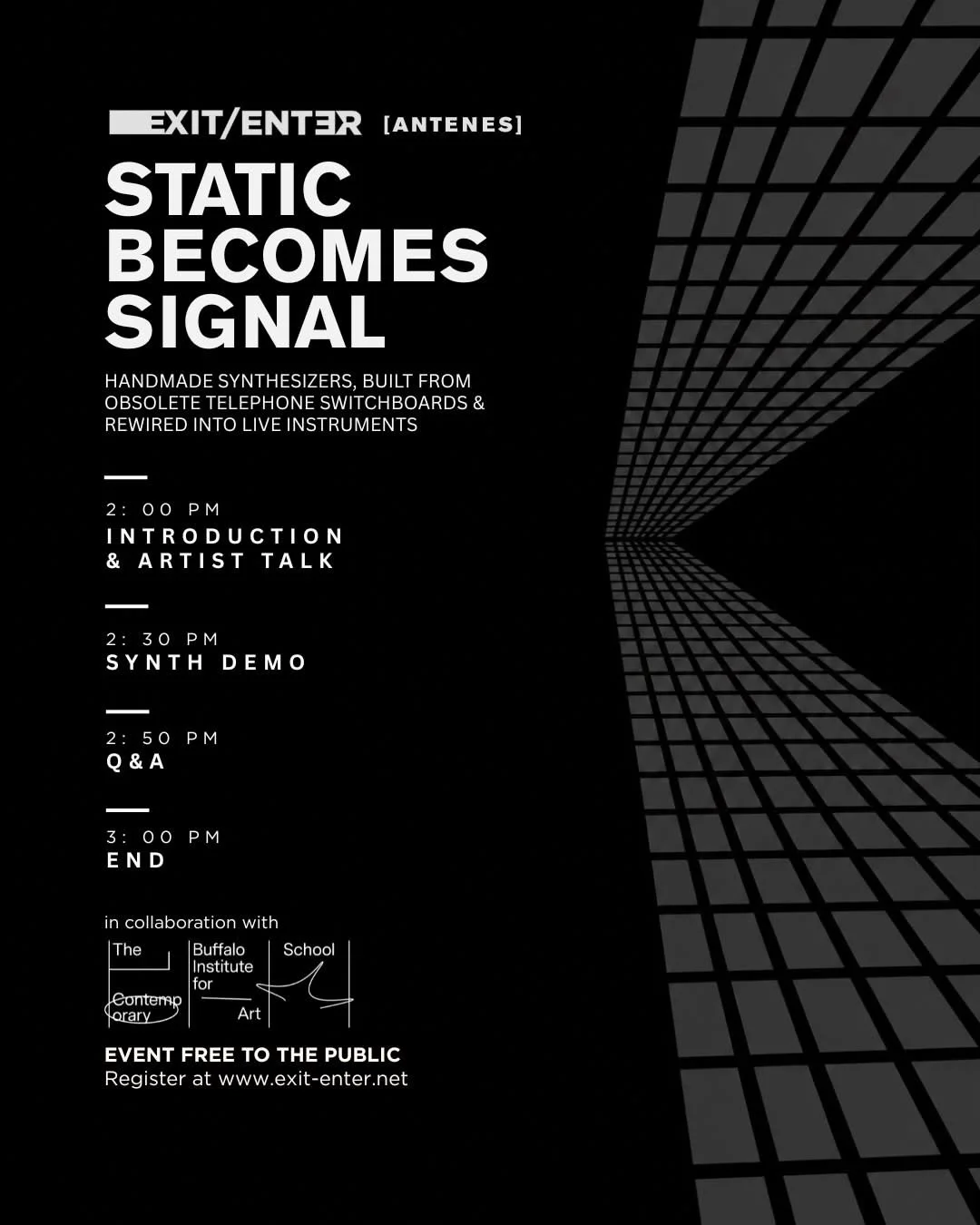
Static Becomes Signal
Static Becomes Signal
in collaboration with EXIT/ENTER & Antenes
registration required at www.exit-enter.net
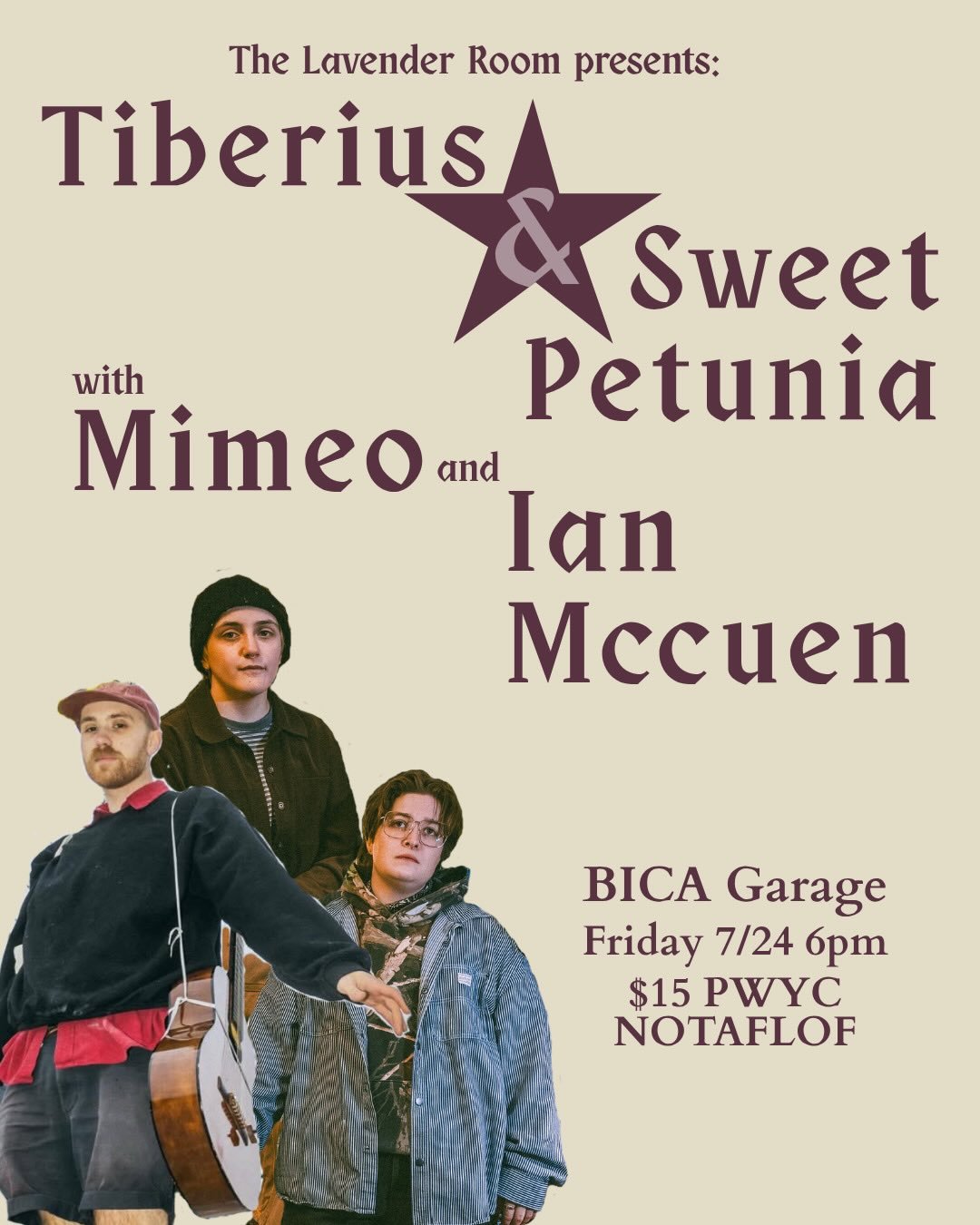
The Lavender Room Presents: Tiberius & Sweet Petunia with Mimeo and Ian Mccuen
The Lavender Room Presents:
Tiberius & Sweet Petunia with Mimeo and Ian Mccuen
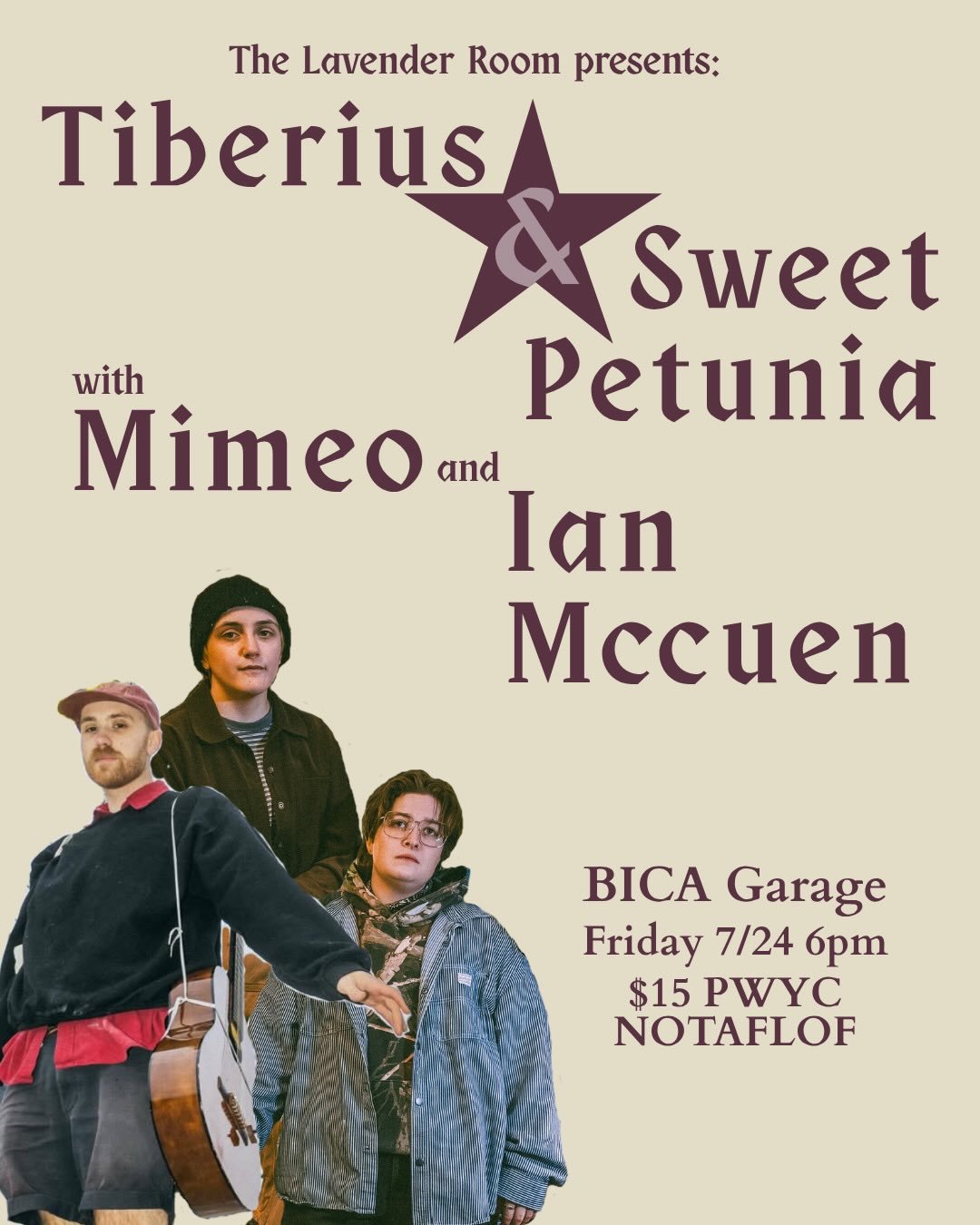
hi!!!! come join us for our first EVER show at the illustrious BICA Garage!
Joining us will be the return of our dear ol pals Sweet Petunia (@sweetpetuniaband), along with our new pal Tiberius (@tiberiuswright) on tour! Joining them will be the fantastic Mimeo (Jake King (@rockinjakeking) & Ronnie Mae Valentine (@dirt_swagg)) and lan Mccuen (@ianmccuen)
* it will be an evening of lofi nonbinary folk music, art, and splendor!
Friday July 24
BICA Garage
Doors 6pm Music 7pm
$15 // PWYC
Folk / Freak Folk / Anti-Folk / Indie / Singer-Songwriter
All Ages
Flyer by @sweetpetuniaband
BICA School Reading Group: Brecht, Threepenny Opera
BICA School Lab | 30 Essex Street
Open to All | Free to Join | No Registration Required
Join us at BICA School for a casual, come-as-you-are reading group that welcomes everyone—whether you've read the text cover to cover or just want to hear what others have to say. We'll explore critical and curious texts together in a space that values open conversation, listening, and learning.
Read ahead if you can, but there's no pressure to be an expert—bring your thoughts, questions, and curiosity.
→ Brecht, Bertolt. The Threepenny Opera. 1928.
What happens when you make crime as charming as it actually is?
Brecht's musical follows a gangster, a corrupt police chief, and a cast of thieves and sex workers through a version of Victorian London that looks suspiciously like Weimar Germany. The songs are catchy. The morals are nonexistent. That's the point. Brecht wanted audiences to enjoy the show and feel uneasy about enjoying it—a deliberate jolt meant to keep people thinking rather than just feeling. It's an early, vivid example of his theory of "epic theater," where the goal isn't to lose yourself in the story but to stay sharp enough to question it. A lively read for anyone curious about how art can entertain and unsettle at the same time, and what theater owes to the world outside the theater.
BICA School Reading Group: Schiller, Letters Upon the Aesthetic Education of Man
BICA School Lab | 30 Essex Street
Open to All | Free to Join | No Registration Required
Join us at BICA School for a casual, come-as-you-are reading group that welcomes everyone—whether you've read the text cover to cover or just want to hear what others have to say. We'll explore critical and curious texts together in a space that values open conversation, listening, and learning.
Read ahead if you can, but there's no pressure to be an expert—bring your thoughts, questions, and curiosity.
→ Schiller, Friedrich. Letters Upon the Aesthetic Education of Man. 1794.
Can beauty make us free?
Writing in the shadow of the French Revolution, Schiller watched a political project meant to liberate people collapse into violence, and went looking for an explanation. His answer: people weren't ready for freedom because they weren't whole—split between reason and feeling, duty and desire. Art, he argues, is what can heal that split. Aesthetic experience isn't decoration or escape; it's training ground, a way of practicing freedom in miniature before we're asked to live it for real. Written as a series of letters, the text is personal and persuasive rather than systematic. A foundational read for anyone wondering what art is actually for, and why a society that wants to change itself might need artists as much as it needs reformers.
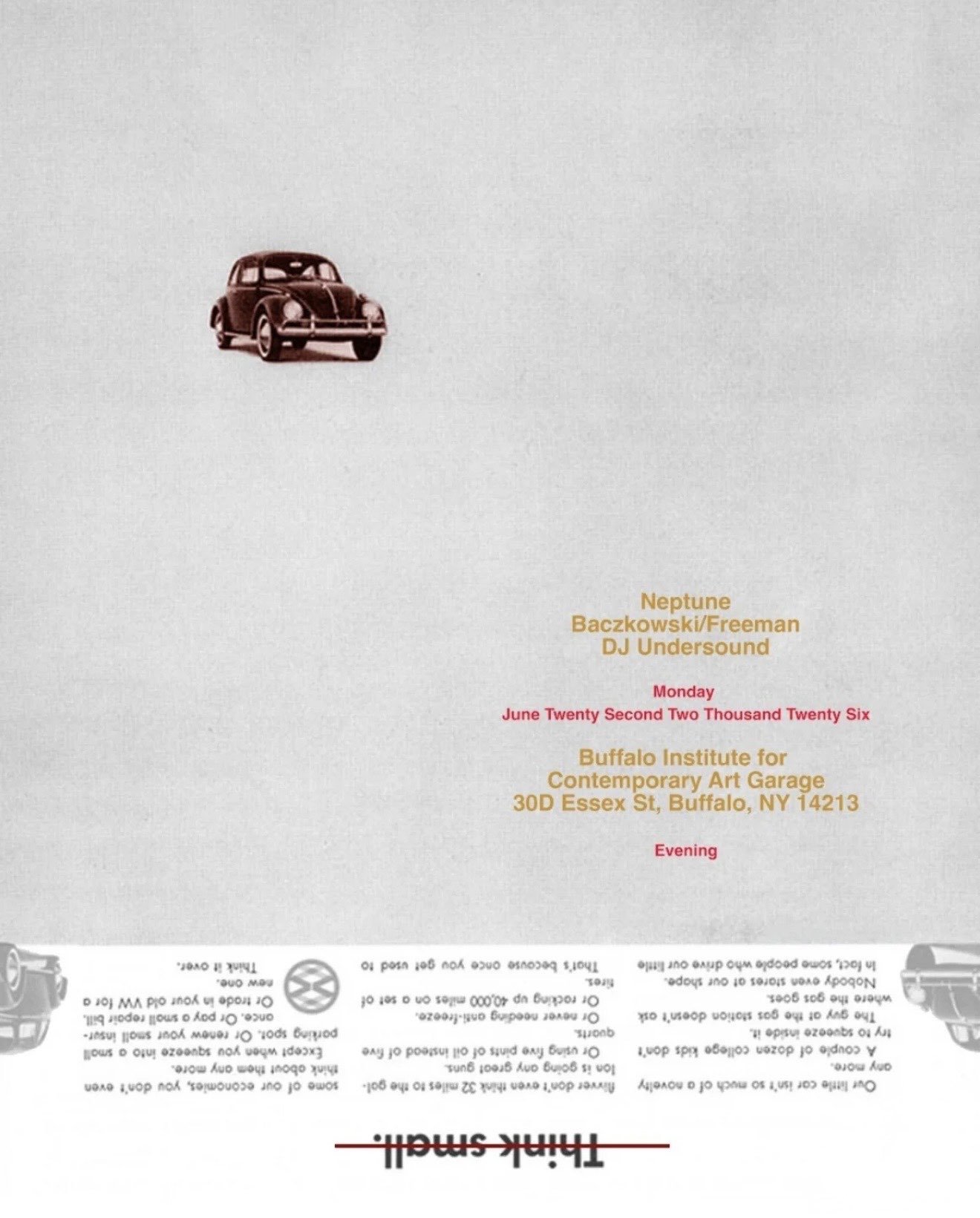
Neptune, Baczkowski/ Freeman, DJ Undersound
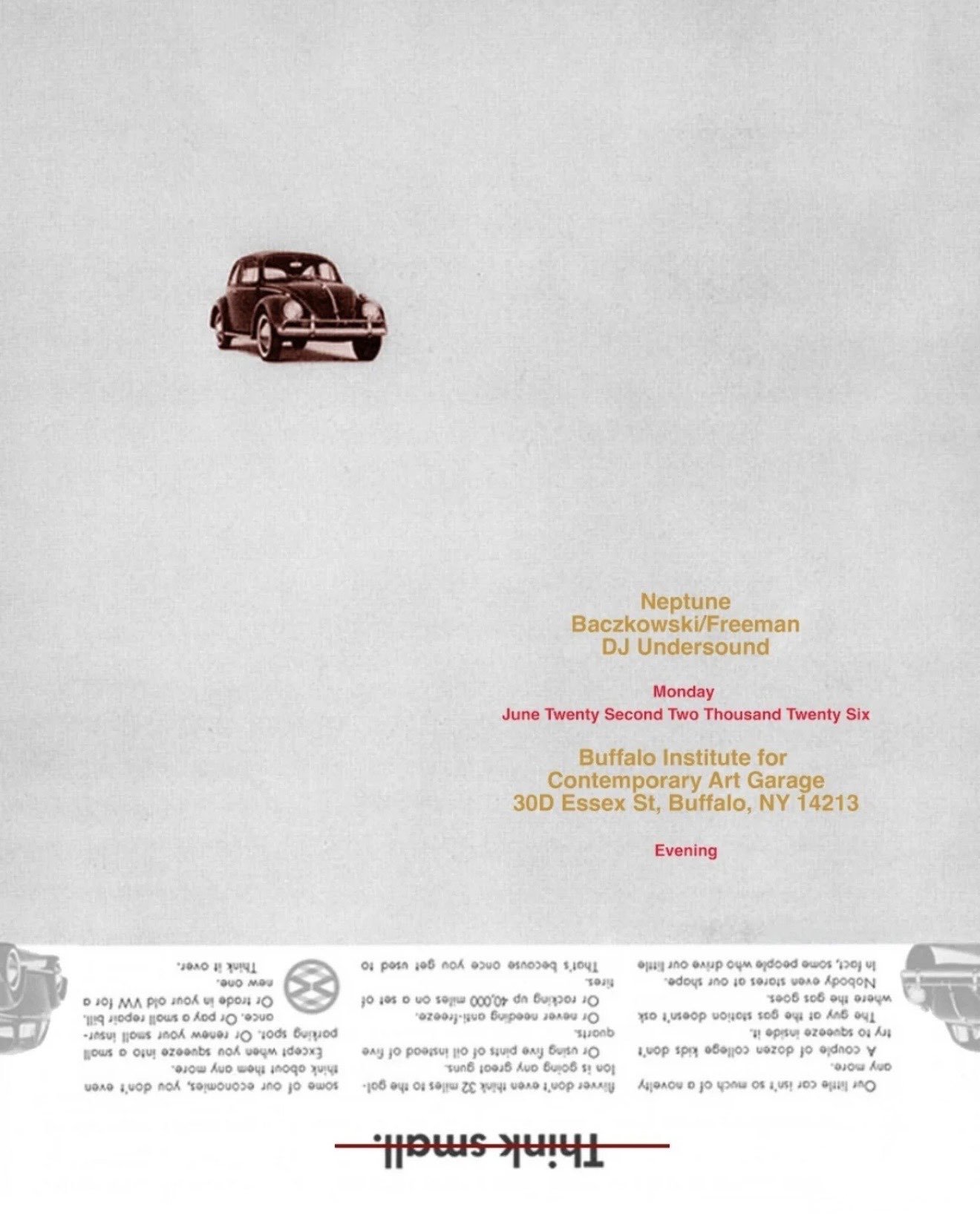
Neptune is a band from Boston, Massachussetts that initially began as a sculpture project. The band played its first show in a basement in late December of '94. Currently Neptune consists of three members playing home-made instruments. The music is noisy and uncombed, a concoction of busted garage and incorrect math created with bike parts, saws, old metal chairs, hobo electronics, amplified springs, metal drums with contact mics inside and other debris found in the trash. With several different members over the years, the music has evolved with the instruments, blending the traditional sounds of rock music with what sounds like mistake-day at the ball bearing factory. Jason sculpts most of the instruments out of scrap metal. Mark has taken an interest in electronics, culminating in the assembly of a small army of nifty synthesizers. Dan has mastered the fine art of building debt and breaking stuff.
$10-20 suggested cover
BICA GARAGE
doors/dj @ 7:30
music @ 8.
done by 10pm
BICA School Reading Group: Hauser, prehistoric Art
BICA School Lab | 30 Essex Street
Open to All | Free to Join | No Registration Required
Join us at BICA School for a casual, come-as-you-are reading group that welcomes everyone—whether you've read the text cover to cover or just want to hear what others have to say. We'll explore critical and curious texts together in a space that values open conversation, listening, and learning.
Read ahead if you can, but there's no pressure to be an expert—bring your thoughts, questions, and curiosity.
→ Hauser, Arnold. "Prehistoric Times." In The Social History of Art, Volume 1. London: Routledge, 1951.
What did art do before there were museums, markets, or audiences?
Hauser opens his sweeping history of art and society at the very beginning—art's earliest known forms, made by hunting and gathering peoples with no concept of "art" as a separate category at all. He argues that art here wasn't decoration or self-expression; it was practical, even magical, tied directly to survival, ritual, and the rhythms of group life. A hunter painting an animal on a cave wall wasn't making a picture—he was trying to act on the world. This chapter sets up the question Hauser carries through the whole book: how does art's purpose, audience, and meaning shift as societies themselves change? A foundational read for anyone curious about why we think of art the way we do now—and how recent that thinking actually is.
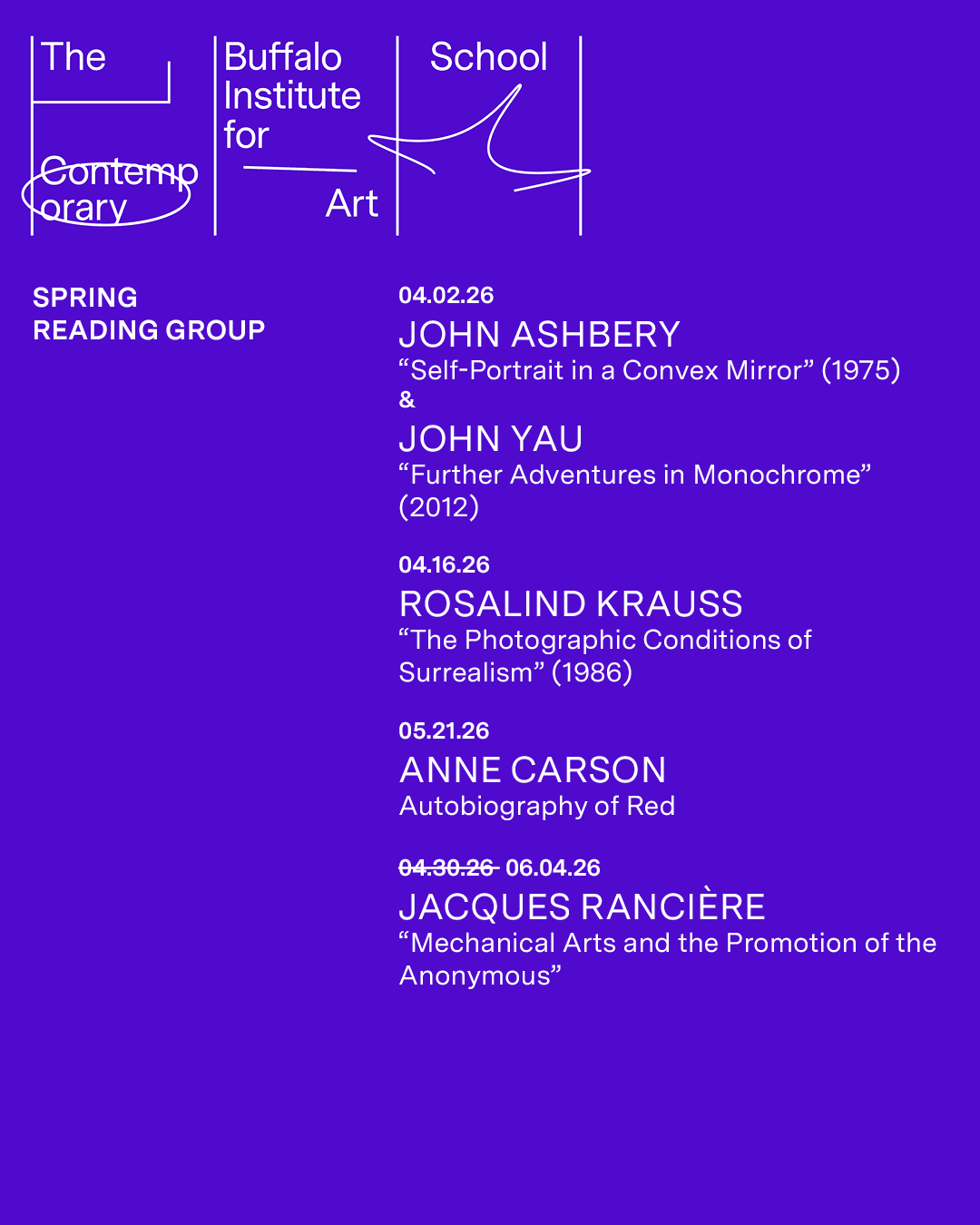
BICA School Reading Group: Ranciere
BICA School Lab | 30 Essex Street
Open to All | Free to Join | No Registration Required
Join us at BICA School for a casual, come-as-you-are reading group that welcomes everyone—whether you’ve read the text cover to cover or just want to hear what others have to say. We’ll explore critical and curious texts together in a space that values open conversation, listening, and learning.
Read ahead if you can, but there’s no pressure to be an expert— bring your thoughts, questions, and curiosity.
Who gets to be seen — and what does art have to do with it?
This essay takes the form of an interview, which makes it one of the more approachable entry points into Rancière's thinking. He's working through a deceptively simple question: how did photography and film come to be recognized as arts? His answer turns the usual story on its head — it wasn't the technology that made them art. It was a prior shift in who and what was considered worthy of being seen at all. Anonymous people, ordinary objects, everyday life: once these became legitimate subjects, the camera could follow. A short, generative read for anyone thinking about what contemporary art is for and who it's made with in mind.
BICA School Reading Group: Anne Carson
BICA School Lab | 30 Essex Street
Open to All | Free to Join | No Registration Required
Join us at BICA School for a casual, come-as-you-are reading group that welcomes everyone—whether you’ve read the text cover to cover or just want to hear what others have to say. We’ll explore critical and curious texts together in a space that values open conversation, listening, and learning.
Read ahead if you can, but there’s no pressure to be an expert— bring your thoughts, questions, and curiosity.
→ Carson, Anne. Autobiography of Red. New York: Alfred A. Knopf, 1998.
A novel in verse about a red-winged monster who wants to be an artist.
Anne Carson retells the myth of Geryon — a winged red creature slain by Herakles — as a coming-of-age story set in the contemporary world. Geryon grows up, falls in love, takes photographs, and tries to figure out what he is. Carson moves between lyric poetry, essay, and narrative without announcing the transitions. The result is a book that feels like several things at once: a love story, a mythology, an autobiography, a meditation on color and memory and what it means to make something. Come having read as much or as little as you can.
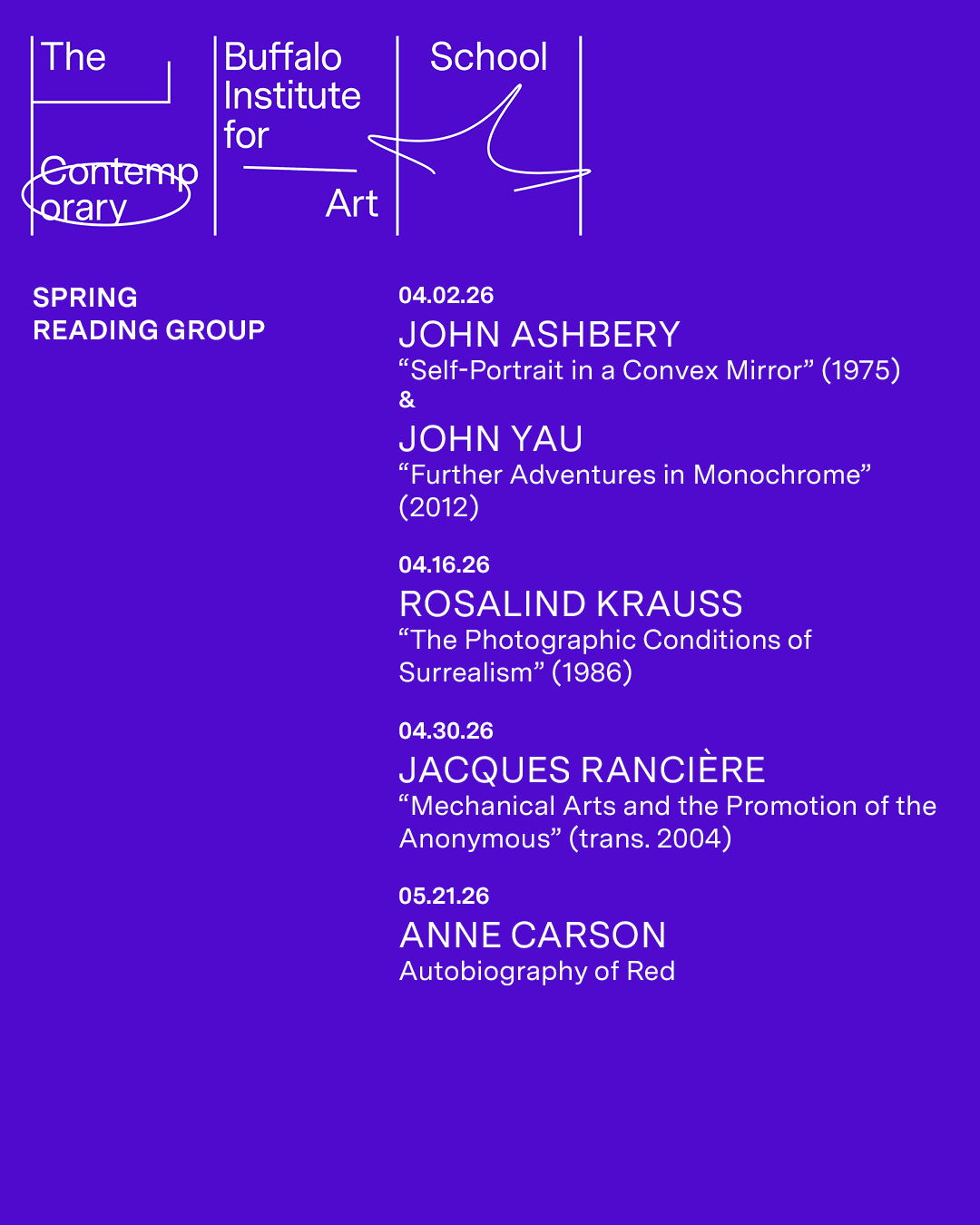
BICA School Reading Group: Rosalind Krauss
BICA School Lab | 30 Essex Street
Open to All | Free to Join | No Registration Required
Join us at BICA School for a casual, come-as-you-are reading group that welcomes everyone—whether you’ve read the text cover to cover or just want to hear what others have to say. We’ll explore critical and curious texts together in a space that values open conversation, listening, and learning.
Read ahead if you can, but there’s no pressure to be an expert— bring your thoughts, questions, and curiosity.
What does photography have to do with Surrealism — and what does Surrealism have to do with us?
Rosalind Krauss argues that photography isn't just a medium Surrealists happened to use — it's structurally central to what Surrealism was doing. The uncanny, the double, the sense that reality has slipped slightly out of joint: Krauss finds these not in subject matter but in the photograph itself. A sharp and rewarding essay for anyone who has ever felt that a picture was showing them something they couldn't quite name.
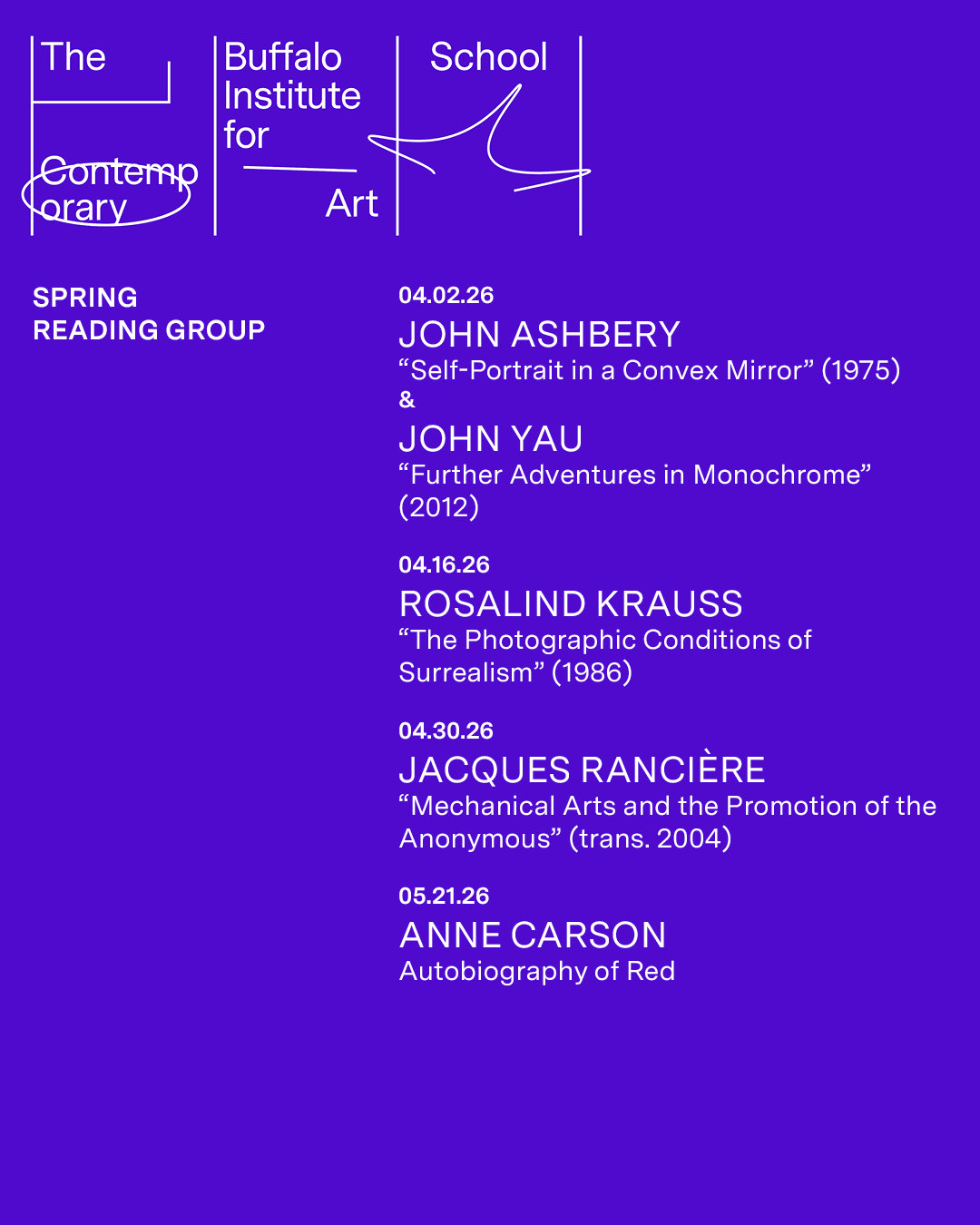
BICA School Reading Group: National Poetry Month
BICA School Lab | 30 Essex Street
Open to All | Free to Join | No Registration Required
Join us at BICA School for a casual, come-as-you-are reading group that welcomes everyone—whether you’ve read the text cover to cover or just want to hear what others have to say. We’ll explore critical and curious texts together in a space that values open conversation, listening, and learning.
Read ahead if you can, but there’s no pressure to be an expert—just bring your thoughts, questions, and curiosity.
→ Ashbery, John. "Self-Portrait in a Convex Mirror." In Self-Portrait in a Convex Mirror. New York: Viking Press, 1975.
→ Yau, John. "Further Adventures in Monochrome." In Further Adventures in Monochrome. Port Townsend, WA: Copper Canyon Press, 2012.
For National Poetry Month, we're reading two poets thinking through what images can and can't do.
John Ashbery's Pulitzer Prize-winning poem takes its starting point from a 1524 painting by Parmigianino — a self-portrait rendered in a convex mirror, distorted world and all. Yau's poem moves through the monochrome as a site of obsession and quiet strangeness. Together they make for an unexpected conversation about color, surface, and what we're really looking at when we look at art.
Optional reading:
→ "John Ashbery 101." Poetry Foundation.
→ "Further Adventures in the Monochrome: A Conversation with John Yau." Los Angeles Review of Books.
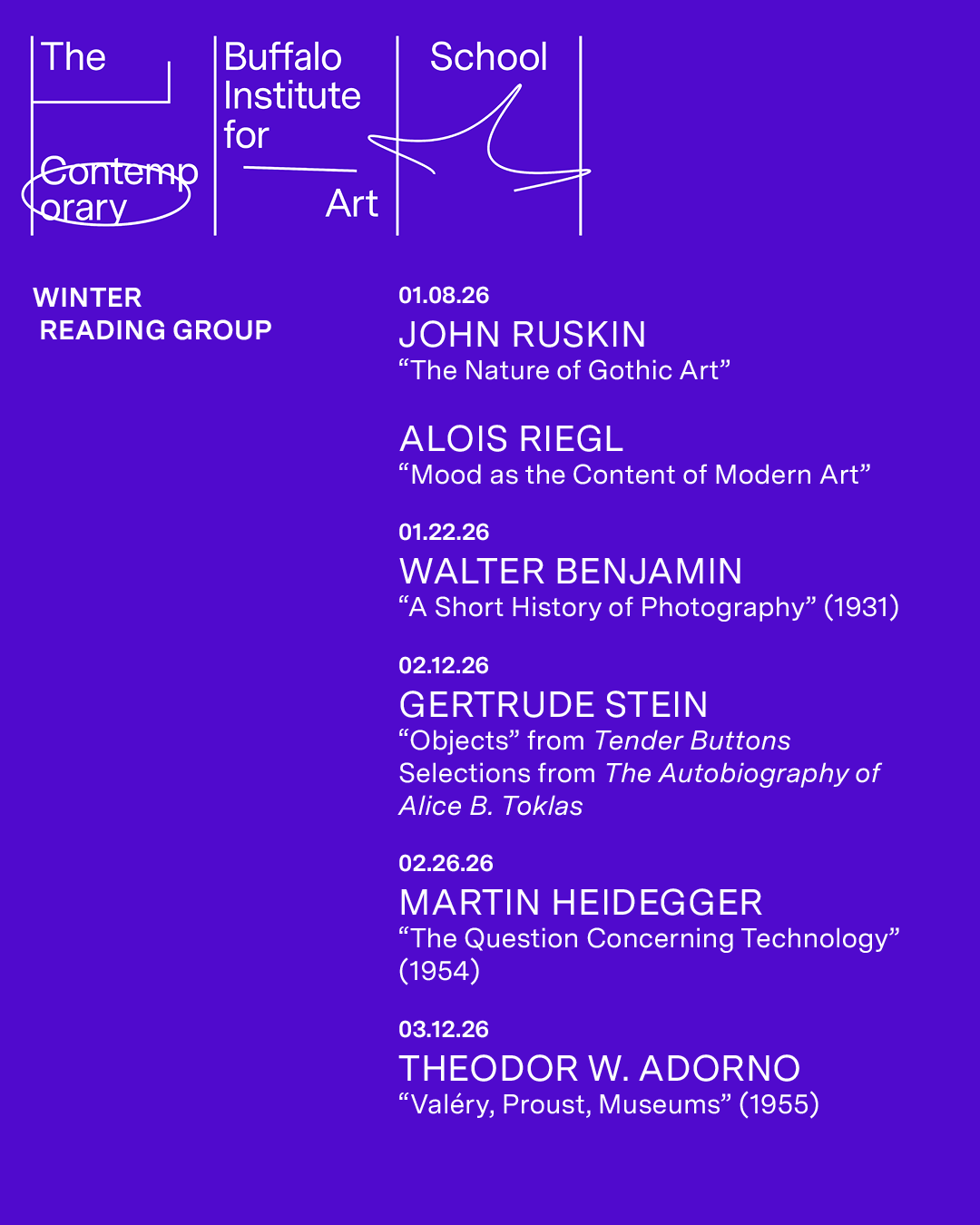
BICA School Reading Group: Adorno
BICA School Lab | 30 Essex Street
Open to All | Free to Join | No Registration Required
Join us at BICA School for a casual, come-as-you-are reading group that welcomes everyone—whether you’ve read the text cover to cover or just want to hear what others have to say. We’ll explore critical and curious texts together in a space that values open conversation, listening, and learning.
Read ahead if you can, but there’s no pressure to be an expert—just bring your thoughts, questions, and curiosity.
What happens to art when we lock it in a museum?
In this short and layered essay, Theodor Adorno takes on two of the 20th century’s major thinkers—Paul Valéry and Marcel Proust—and their opposing takes on what museums do to art. Is the museum a mausoleum? A memory palace? A space for spiritual preservation or cultural disintegration?
This final winter session invites reflection on the role of museums in modern life and the ways institutions shape our encounters with art. Bring your thoughts, critiques, or questions about that one painting you keep visiting—or avoiding.
BICA School Reading Group: Heidegger
BICA School Lab | 30 Essex Street
Open to All | Free to Join | No Registration Required
Join us at BICA School for a casual, come-as-you-are reading group that welcomes everyone—whether you’ve read the text cover to cover or just want to hear what others have to say. We’ll explore critical and curious texts together in a space that values open conversation, listening, and learning.
Read ahead if you can, but there’s no pressure to be an expert—just bring your thoughts, questions, and curiosity.
What even is technology—and what if it’s not just the stuff we invent, but a way of seeing the world?
In this dense but rewarding essay, Heidegger asks us to reconsider our relationship with technology—not as tools or machines, but as something more fundamental. He introduces ideas like “enframing” and “revealing” to suggest that the modern technological worldview doesn’t just shape what we build—it shapes how we understand truth, being, and even art.
We’ll break it down together (don’t worry if it feels slippery), and think about what this means in an AI-saturated, hyperconnected world.
BICA School Reading Group: Gertrude Stein
BICA School Lab | 30 Essex Street
Open to All | Free to Join | No Registration Required
Join us at BICA School for a casual, come-as-you-are reading group that welcomes everyone—whether you’ve read the text cover to cover or just want to hear what others have to say. We’ll explore critical and curious texts together in a space that values open conversation, listening, and learning.
Read ahead if you can, but there’s no pressure to be an expert—just bring your thoughts, questions, and curiosity.
→ Stein, Gertrude. “Objects.” In Tender Buttons. Mineola, NY: Dover Publications, 1997, 3–16.
→ Additional Essay TK
Bring your thoughts, your snapshots, or your questions about what makes an image powerful.
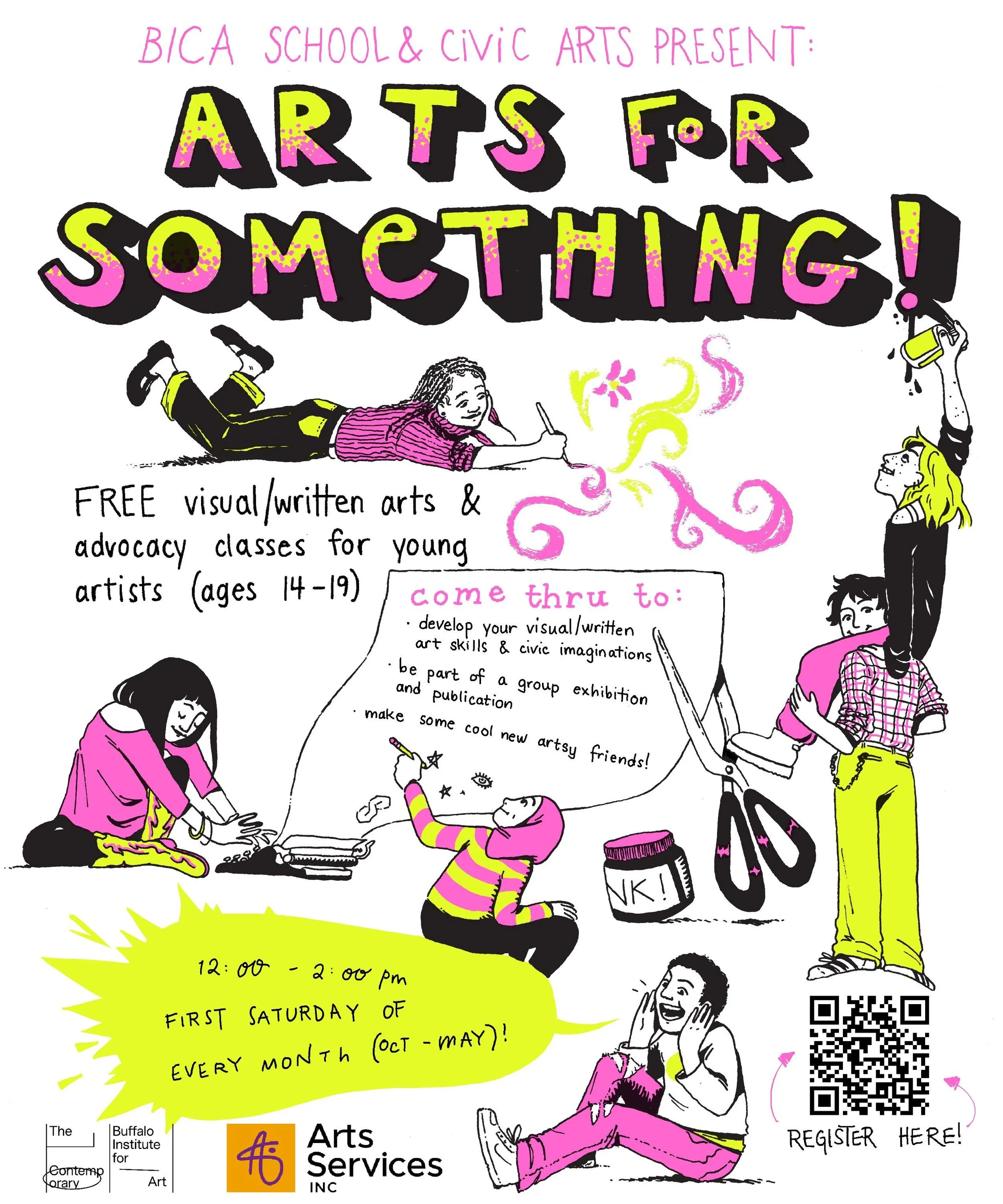
Arts for Something, February
Hosted at BICA in collaboration with BICA School and Civic Arts (a project by teaching artist Robin Lee Jordan), Arts for Something! is an interdisciplinary program for young and emerging artists (ages 14–19) exploring the intersection of art and civic engagement.
Over the course of the series, participants will build creative skills—like screen-printing, zine-making, sewing, literary arts, and specialized visual arts—while learning how these tools can be used to support civic initiatives such as social justice, activism, and local community needs.
Young artists who commit to all eight sessions (with up to two excused absences) will have the opportunity to create and present a civic arts–inspired project in any medium. These projects will be featured in a collaborative zine and shared during a final exhibition and celebration in June.
Workshops take place the first Saturday of every month, October through May (skipping January), from 12–2 PM.
Photography as a Daily Practice
Led by Nando Alvarez-Perez and Palmer Segner
Together, we'll embark on a photographic scavenger hunt through Buffalo’s West Side, using phone and digital cameras to explore our surroundings with fresh eyes. As we track down colors, textures, objects, and moments, we’ll reflect on how photography can be a fun daily habit—but also a tool for deeper awareness, helping us attune to the subtle rhythms of our environment and our community. More than documentation, we’ll approach photography as a practice of radical attention and self-expression: a way of seeing the world more clearly, and seeing ourselves more fully within it.
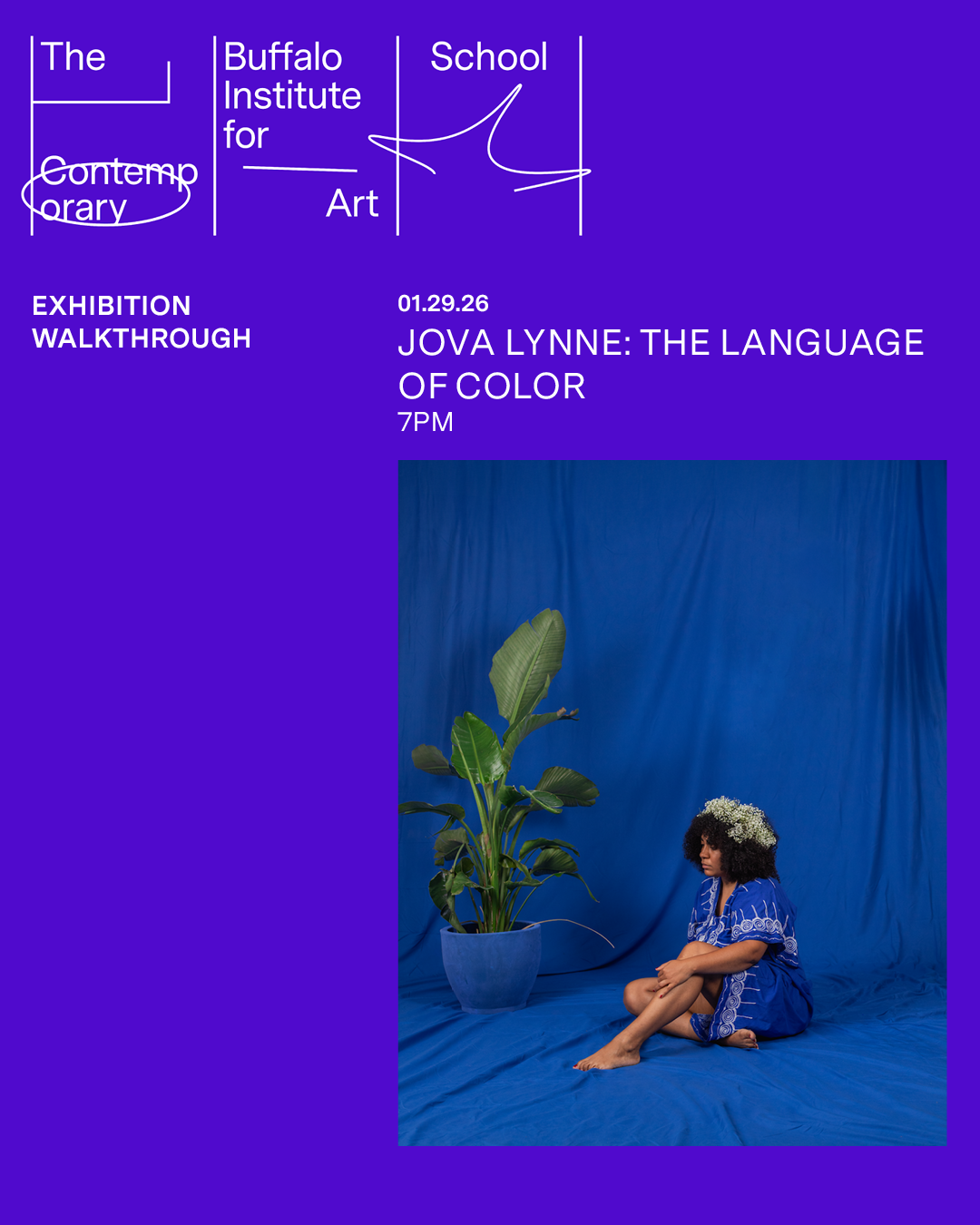
BICA School Exhibition Walkthrough: Jova Lynne
Join us to preview the exhibition Jova Lynne: The Language of Color! Lynne will give a walkthrough of the exhibition as it comes together, give insights into her artistic practice, and talk about the influences at play in her current body of work.
This BICA School event is open to the public.
BICA School Reading Group: A Short History of Photography
BICA School Lab | 30 Essex Street
Open to All | Free to Join | No Registration Required
Join us at BICA School for a casual, come-as-you-are reading group that welcomes everyone—whether you’ve read the text cover to cover or just want to hear what others have to say. We’ll explore critical and curious texts together in a space that values open conversation, listening, and learning.
Read ahead if you can, but there’s no pressure to be an expert—just bring your thoughts, questions, and curiosity.
What do we see in a photograph—and what do we miss?
In this richly layered essay, Walter Benjamin explores how photography transformed our relationship to images, memory, and truth. Written just a few years before The Work of Art in the Age of Mechanical Reproduction, this piece previews many of Benjamin’s key concerns: aura, authenticity, reproducibility, and the politics of visual culture.
We’ll talk about early photographic portraiture, what it means to capture a face, and how new technologies continue to reshape how we look—and how we’re seen.
Bring your thoughts, your snapshots, or your questions about what makes an image powerful.
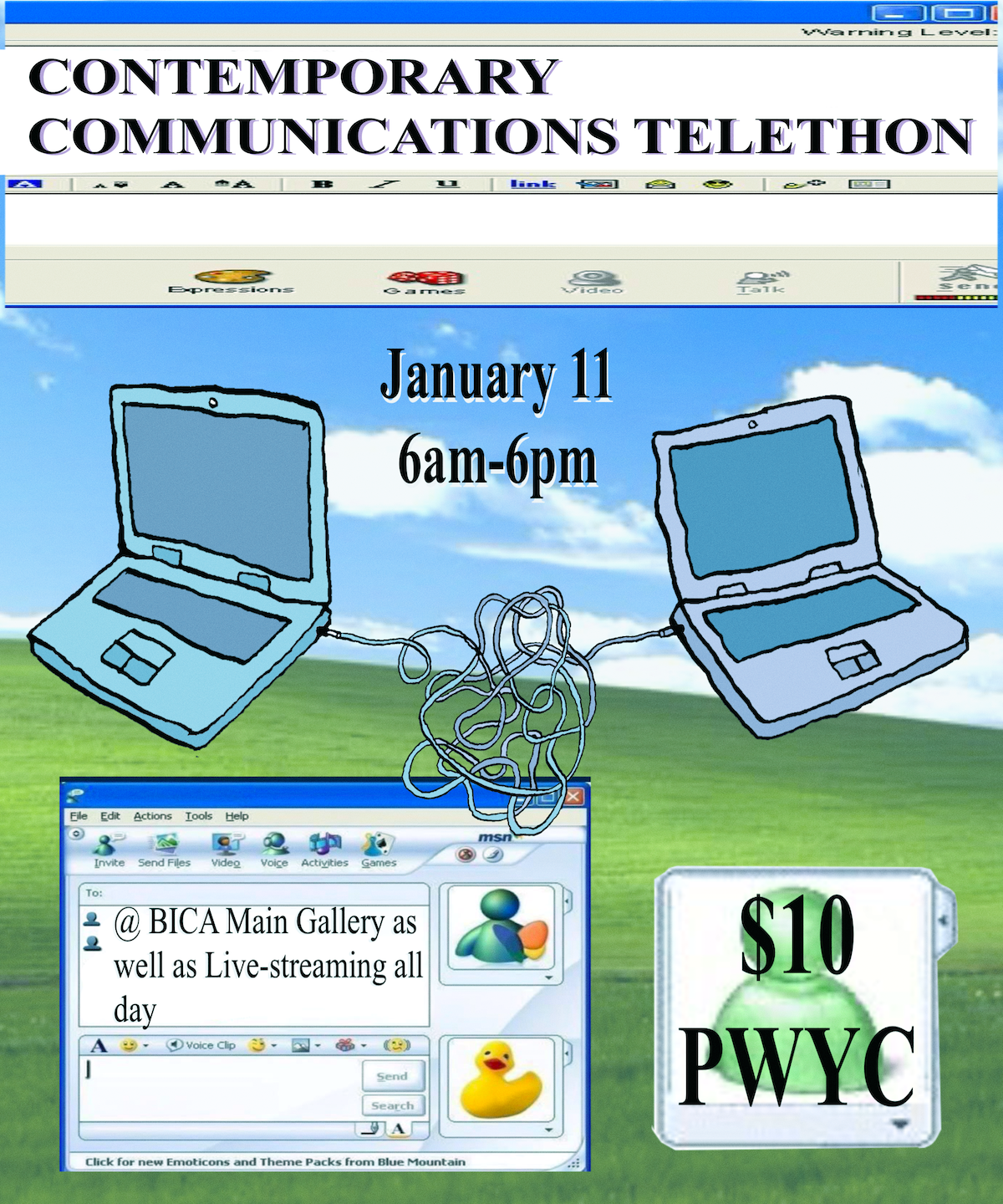
Contemporary Communications Telethon
Step out of the cold (or don’t) and join the CONTEMPORARY COMMUNICATION TELETHON LIVESTREAM!!
LIVE in BICA’s Main Gallery OR LIVEstreamed, this 12 hour event (6am to 6pm) features a variety of sonic audio experiences from the Buffalo area, as we raise funds for BICA School. Love what you see? We suggest a $10 donation to support our school. Come make some friends or just lurk in the chat!
Schedule
6-9am auxcab, DJ TwinPuppy, 4.ds
9-10am Skenderton, BlueBag Poetry Block
10-11am Chango4, happygroupppp
11-12pm Nerix Jazz Set, Radio Calisthenics, Ryan Bell, James Pardue and Tim Georger
12-2pm Devon logel, Captain Lemo
2-4pm Degi-Degi, Headbutt
4-6pm GENRE BLENDER (puhgeez X jake king, chango X SAINT BLIND, Lex X Aneris, Ryan X Lex X Jack X Host Nick)
Organized by Silas Rubeck.
BICA School Reading Group: Ruskin & Riegl
BICA School Lab | 30 Essex Street
Open to All | Free to Join | No Registration Required
Join us at BICA School for a casual, come-as-you-are reading group that welcomes everyone—whether you’ve read the text cover to cover or just want to hear what others have to say. We’ll explore critical and curious texts together in a space that values open conversation, listening, and learning.
Read ahead if you can, but there’s no pressure to be an expert—just bring your thoughts, questions, and curiosity.
We’re kicking off our winter season with two short, spirited texts that ask: What is art for—and what does it reflect about the people who make it?
John Ruskin’s “The Nature of Gothic” is a defense of craftsmanship, labor, and the values of imperfection—part art history, part social manifesto. Paired with that, we’ll read Alois Riegl’s “Mood as the Content of Modern Art,” where the 19th-century theorist suggests that it’s not subject matter or style that makes art “modern,” but the inner feelings it conveys.
Together, these texts open up big questions about ornament, intention, emotion, and the role of the artist in society—questions we’ll be carrying all winter long.
Know Your Rights: Legal Essentials for Artists with Eddie King

A workshop designed to delve into how to protect your art and the legal remedies available to artists in disputes. Topics will cover the basics of Copyright law, trade mark law, contract law, and what you can do if you feel like your art has been infringed upon.
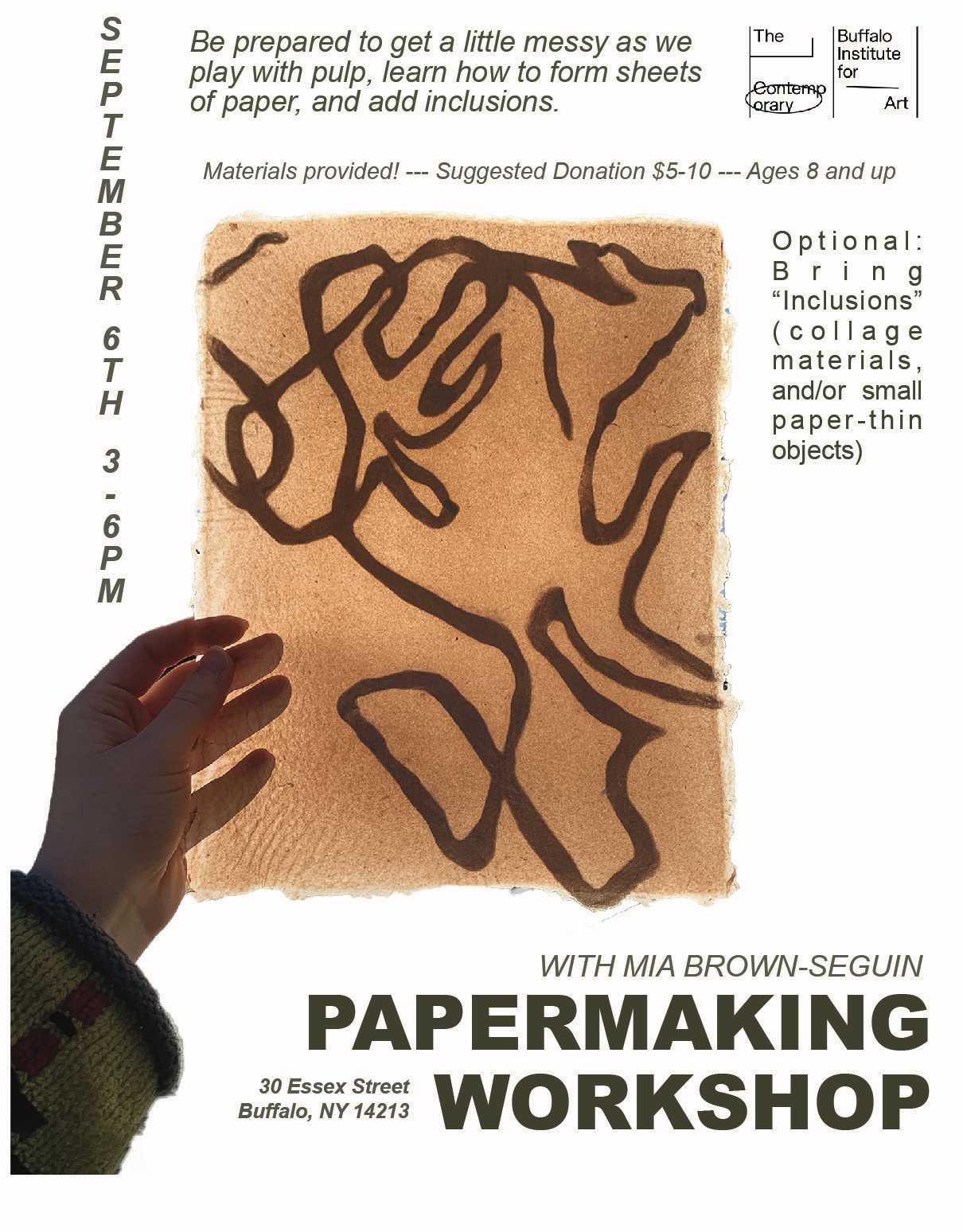
Papermaking Workshop

Papermaking workshop with Mia Brown-Seguin.
September 6th, 2025 3-6pm
Be prepared to get a little messy as we play with pulp, learn how to form sheets of paper, and add inclusions.
Materials provided!
Suggested donation $5-10
Ages 8 & up
Optional: bring your own “inclusions” (collage materials and/or small paper thin objects)
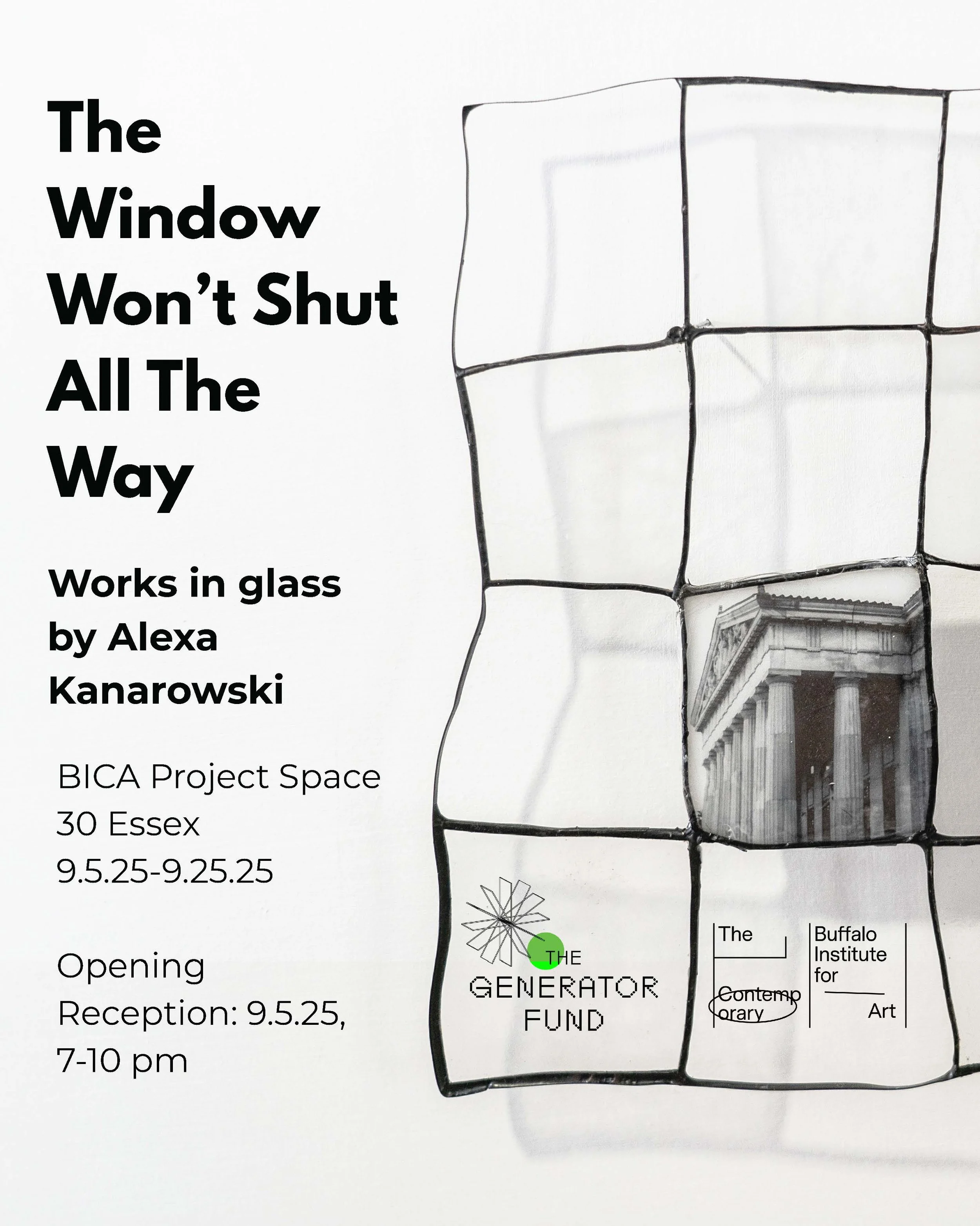
The Window Won’t Shut All the Way, Opening Reception
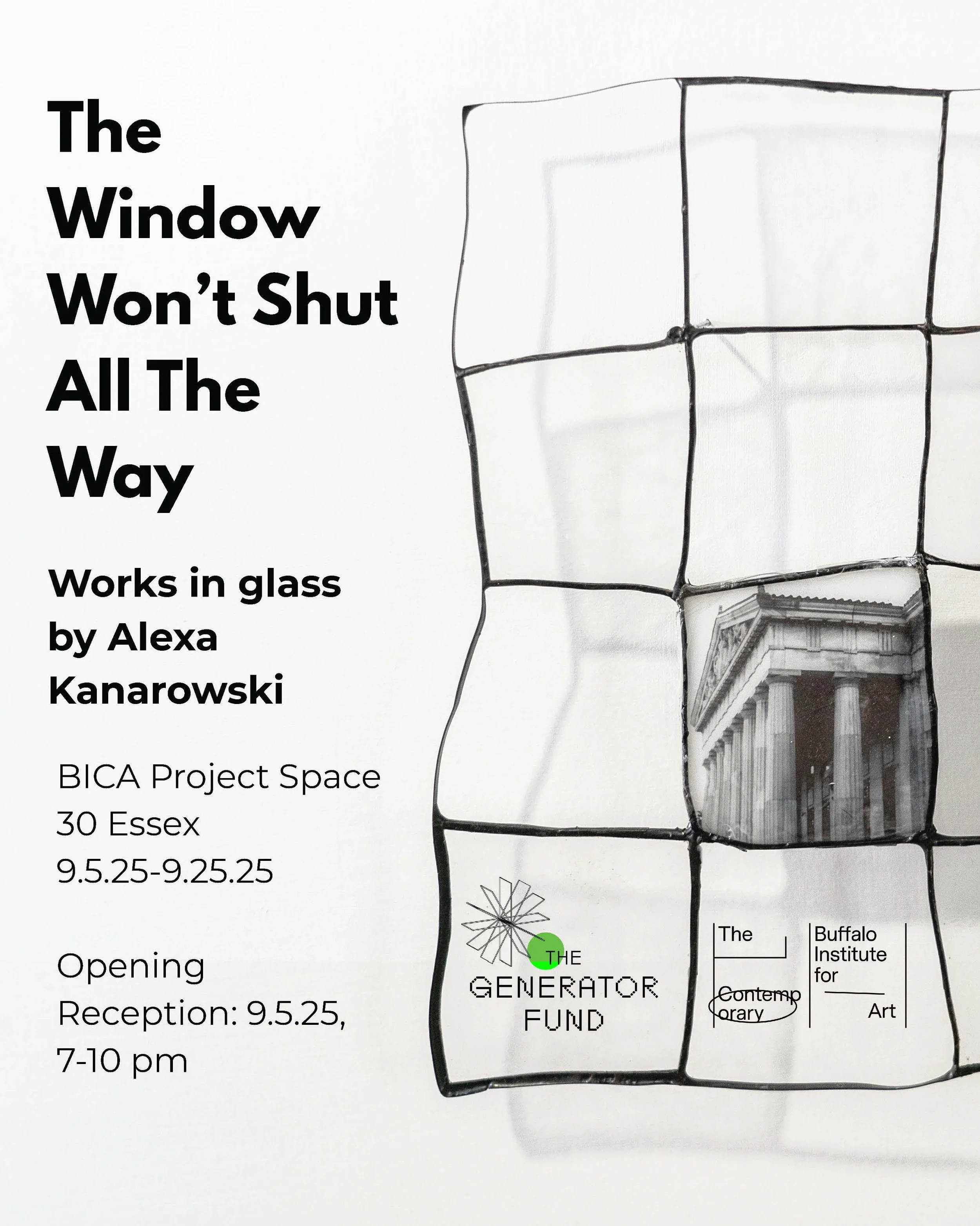
Alexa Kanarowski: The Window Won’t Shut All the Way
09.05.25 – 09.24.25
Opening Reception Friday, September 5, 7-10PM
When we look out a window, does the landscape look back in? The Window Won’t Shut All the Way investigates the meaning of glass, and the inability to fully separate ourselves from what we see.
Photographic media imposed on glass forms grapples with the passage of time and the vernacular landscape. Squares and grids appear repeatedly throughout the work. Often altered or in a sense of decay, the grid is reminiscent of city blocks and the changes they undergo over time. By using imperfect squares, the work takes on a confused identity. Highlighting the transparent qualities of glass with a muted color scheme, Kanarowski engages the viewer in both what is and what has been. The expected language of stained glass is subverted to engage with the simple language of a plain window, and the landscape that is seen through a window. Much of the glass is found, further solidifying the connection between the built environment, the work, and ghosts of a time gone by.
Combined with glass, Kanarowski uses the technique of Polaroid emulsion lifts to create ghostly images. Whether pasted on the surface of a piece or sandwiched between glass like a sample between microscope slides, the photographs become a part of the glass and emphasize its fragility.
The process of Polaroid emulsion lifts makes physical the notion of time. Because they are taken with a Polaroid camera, the images must be transferred to glass within hours of their exposure. The process itself is prone to unexpected results, allowing the one-of-a-kind image to take on its own form and autonomy. Shooting in the square format of Polaroids places further emphasis on the grid like structures that appear throughout the work, while encouraging a simplistic approach to composition.
This body of work also engages in tensions between art and craft. Working with a craft like stained glass, Kanarowski both accedes to and distances herself from the rules of the media. Her reliance on grids brings her back to a motif that is often present in her practice, quilts and patchwork. In Refuse Quilt, Kanarowski takes this quite literally, crafting a quilt out of the waste products of Polaroid Emulsion lifts, and the haunting ephemeral landscapes they produce.
Alexa Kanarowski is a photographer based in Buffalo, New York. Through investigating systems that combine to make our present moment, she focuses on the landscape, cultural, and systemic patchworks that contribute to defining the everchanging now. Frequently working in photo series, Kanarowski creates quilt-like narratives that are sensitive to memory, labor, and landscape. In addition to photobooks, her practice encompasses craft practices, using stained glass and sewing to further elucidate the patchwork nature of the contemporary moment.
Kanarowski is a member of the Buffalo Institute for Contemporary Art’s BICA School. She holds a Bachelor of Fine Arts from Cornell University, and her work has been exhibited throughout New York State, such as a solo show at the Johnson Museum of Art (Ithaca, NY). She has been the recipient of multiple awards and grants, including the Edith Adams and Walter King Stone Memorial Prize and the Gibian Rosewater Traveling Research Award.
Reading Group: The Cuteness of the Avant-Garde
Open to All | Free to Join | No Registration Required
Join us at BICA School for a casual, come-as-you-are reading group that welcomes everyone—whether you’ve read the text cover to cover or just want to hear what others have to say. We’ll explore critical and curious texts together in a space that values open conversation, listening, and learning.
Read ahead if you can, but there’s no pressure to be an expert—just bring your thoughts, questions, and curiosity.
→ Ngai, Sianne. “The Cuteness of the Avant-Garde.” Critical Inquiry 31, no. 4 (Summer 2005): 811–847.
Why do we describe some things as “cute”? And what happens when the avant-garde—the sharp, strange, and experimental—gets tangled up with the soft, sweet, and small?
In this session, we’ll read Sianne Ngai’s “The Cuteness of the Avant-Garde,” a smart and surprisingly fun essay that explores how aesthetic categories like “cute” shape the way we perceive objects, bodies, and artworks. Ngai digs into everything from Kant to Keane paintings to unpack what cuteness reveals about power, vulnerability, and our deeply weird relationship with things.
Bring your thoughts, your questions, or your love/hate feelings about Sanrio characters. We’re here for all of it.
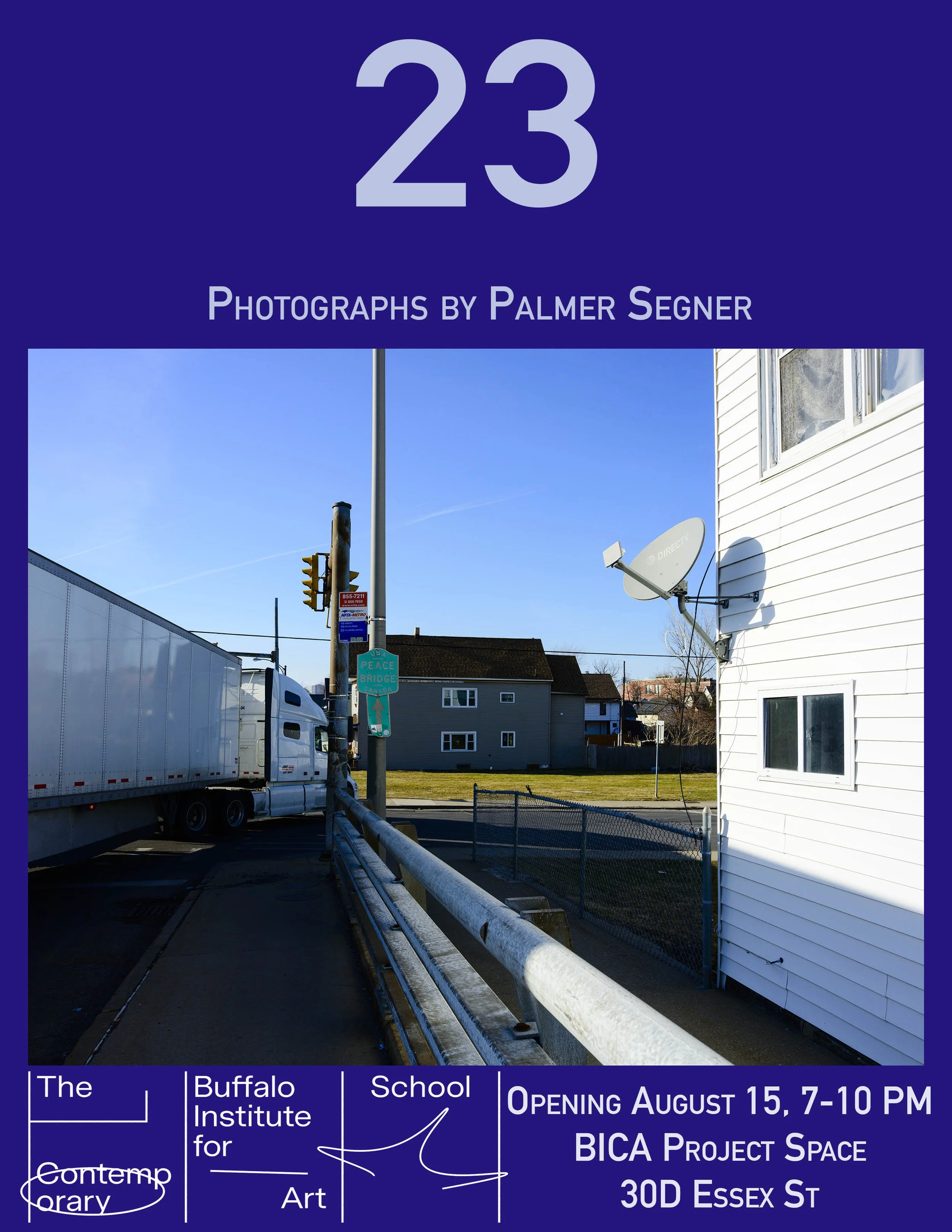
23, Opening reception
Palmer Segner: 23
Opening Reception, August 15, 7-10pm
BICA School Project Space
In addition to being a picture making process, photography is also a game. The point of this game, as John Szarkowski said, “is to know, love, and serve sight, and the basic strategic problem is to find a new kind of clarity within the prickly thickets of unordered sensation.” These photographs were made along the route of the number 23 bus over the course of a few days in March 2025 and are presented here as a series of 20x24” C-Prints.
Palmer Segner, b. 1990, is a photographer living and working in Buffalo, NY.
Reading Group: The Railway Journey
Open to All | Free to Join | No Registration Required
Join us at BICA School for a casual, come-as-you-are reading group that welcomes everyone—whether you’ve read the text cover to cover or just want to hear what others have to say. We’ll explore critical and curious texts together in a space that values open conversation, listening, and learning.
Read ahead if you can, but there’s no pressure to be an expert—just bring your thoughts, questions, and curiosity.
How did trains change how we see the world? And what does that have to do with art, technology, and even attention spans?
This week we’re reading Wolfgang Schivelbusch’s The Railway Journey, an exploration of how the invention of the railroad reshaped time, space, and human perception in the 19th century. The book blends cultural theory, history, and a bit of poetic flair as it traces how technology altered everyday experience—and how those changes still echo in modern life.
It’s part historical study, part philosophical reflection, and all up for discussion. Come ready to share your thoughts or simply ride along with us.
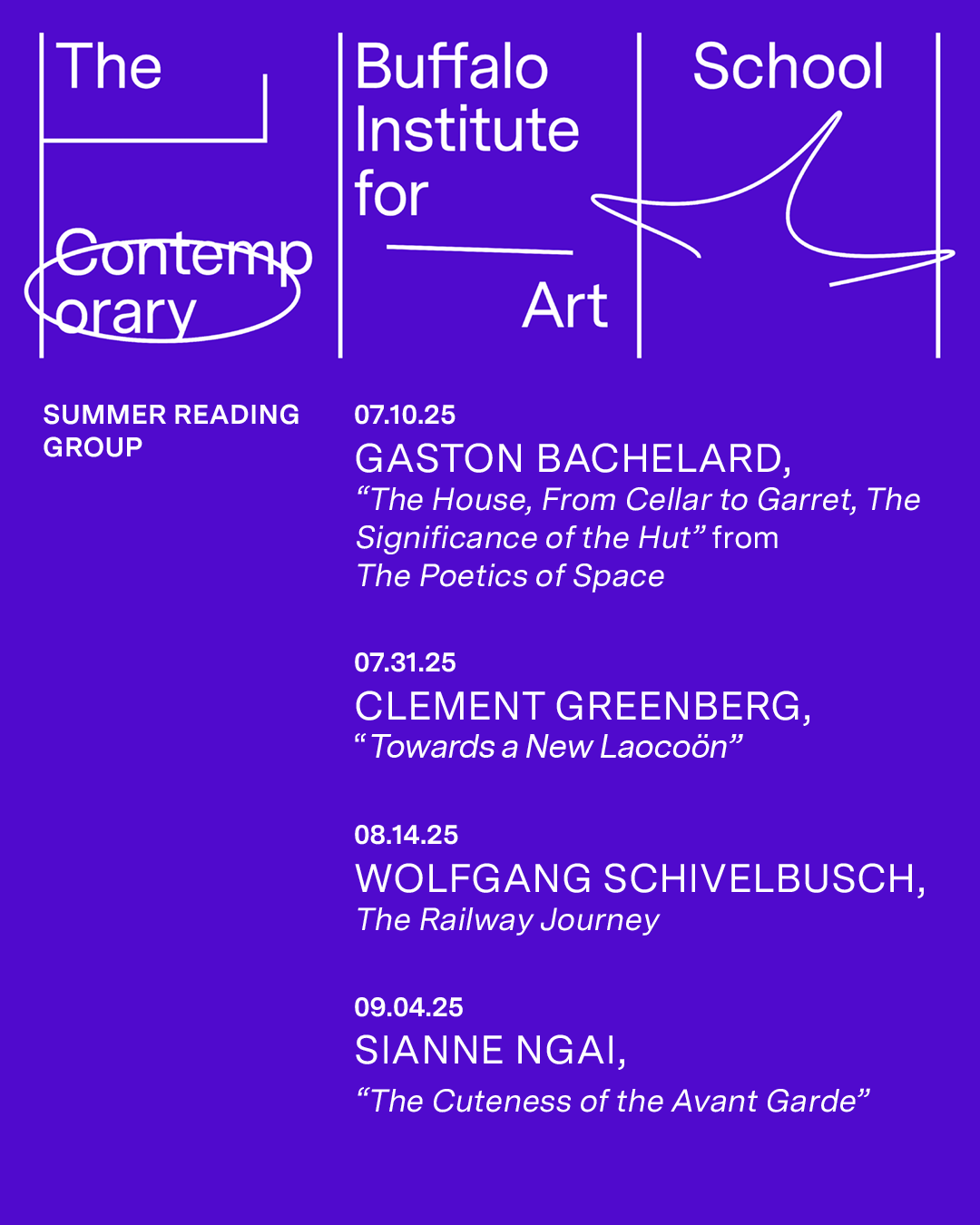
Reading Group: Towards a New Laocoön
Open to All | Free to Join | No Registration Required
Join us at BICA School for a casual, come-as-you-are reading group that welcomes everyone—whether you’ve read the text cover to cover or just want to hear what others have to say. We’ll explore critical and curious texts together in a space that values open conversation, listening, and learning.
Read ahead if you can, but there’s no pressure to be an expert—just bring your thoughts, questions, and curiosity.
→ Greenberg, Clement. “Towards a New Laocoön.” Partisan Review 7, no. 4 (July–August 1940): 296–310.
* 07.30 this link has been updated, the previous link was to an abridged version of the same essay.
What’s the relationship between painting, music, and literature—and why did modernist art care so much about keeping them separate?
Join us as we dig into Clement Greenberg’s 1940 essay “Towards a New Laocoön”, a foundational (and famously opinionated) text in the history of modern art criticism. Greenberg argues that painting should embrace its “essential qualities”—like flatness and color—and resist the temptation to imitate other art forms. Whether you agree, disagree, or want to push the conversation in new directions, this session is all about engaging with the ideas that shaped 20th-century art—and maybe complicating them a little, too.
Let’s read, talk, and think together.